
 English
  Français
  Tiếng Việt
  Italiano
  Nederlands
  Türkçe
  Svenska
  Polski
  Română
  Latviešu
  한국어
한국어  Русский
  Español
  Deutsch
  Українська
  Português
  العربية
  Indonesian
  Čeština
  Suomi
Suomi  Eesti
Eesti  Български
  Dansk
Dansk  Lietuvių
  Bokmål
  Slovenčina
  Slovenščina
  Ελληνικά
  Magyar
  עברית
עברית 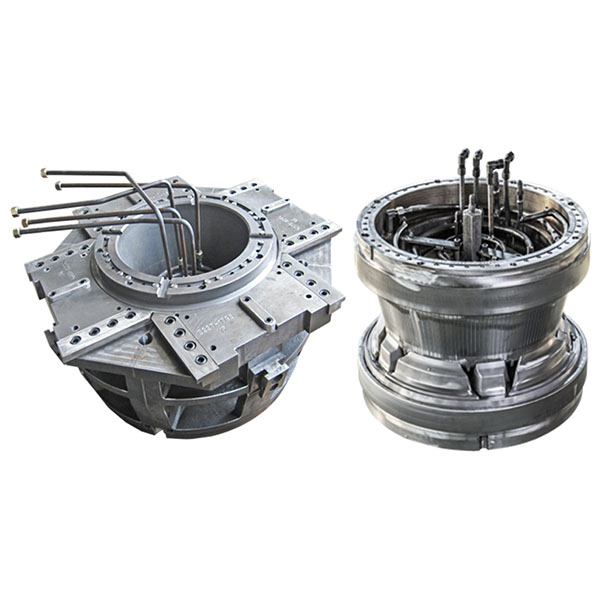
wheel hub differential pressure die casting mould tooling
Wheel hub differential pressure die casting moulds are specifically designed and manufactured for the differential-pressure die casting process, where the metal is driven into the cavity by controlling the pressure difference between the inside and outside of the mould cavity.
Description
Wheel hub differential pressure die casting moulds, combined with precise pouring control and well-designed venting and vacuum systems, can produce wheel hub castings with high density, stable dimensions, and excellent surface quality. They are suitable for high-volume production of wheel hubs for passenger cars, commercial vehicles, and construction vehicles.
Structure and design key points:
- Cavity and parting surfaces: Optimize parting line locations and cavity contours according to the complex geometry of the wheel hub to ensure smooth melt flow and ease of cleaning during differential-pressure filling.
- Runners and pouring control: Design dedicated bottom-pour or side-pour systems for differential-pressure casting, paired with valves or flow-control devices to precisely control melt rise speed and filling rhythm, reducing the risk of porosity and cold shuts.
- Venting and vacuum system: Provide effective vent grooves and vacuum extraction ports at critical locations, and pair them with online vacuum equipment to reduce trapped air and improve part density.
- Cooling system: Lay out appropriate cooling channels and local cooling circuits to ensure uniform mould temperature, shorten solidification time, and reduce thermal stress differentials.
- Machining allowances and locating datums: Reserve machining allowances for key mating surfaces and finish-machined faces, and design clear clamping datums and locating pins to ensure assembly and post-processing accuracy.
- Ejection and demoulding mechanisms: Design reliable ejection pins, sliders, or parting mechanisms tailored to the hub geometry to ensure stable demoulding without damaging the casting surface.
Manufacturing processes:
- Precision machining: Use CNC roughing and finishing, wire EDM (WEDM), slow-feed wire cutting, sinker EDM, precision forming EDM, and precision grinding operations to ensure the high accuracy and surface condition of cavities and cores.
- Assembly and heat-treatment: Heat-treated mould components must be assembled following strict procedures, with fit inspections and clearance corrections to ensure closing accuracy and synchronized movement.
- Sealing and piping machining: Machine high-quality sealing faces and fittings for the differential-pressure and vacuum systems, and arrange pressure-resistant water and air lines to meet long-term stable operation requirements.
- Surface finishing: Perform necessary polishing or texture treatment on cavity surfaces to balance demoulding performance and final casting surface requirements.
Trial moulding and process validation:
- First-article validation: Conduct trial moulding to verify differential-pressure filling curves, vacuum and venting effectiveness, cooling uniformity, and demoulding behavior, recording key parameters such as temperature, pressure, rise speed, and vacuum level.
- Defect analysis and optimization: For observed defects (such as porosity, shrinkage, cold shuts, or local warpage), adjust pouring curves, venting layout, or cooling strategy, and modify the cavity if necessary to eliminate defects.
- Process locking: After successful trial moulding, create a complete process parameter document (pouring curves, vacuum parameters, mould temperature, cooling flow rates, etc.) to facilitate repeatable mass production and quality control.
Typical application areas of wheel hub differential pressure die casting moulds:
- High-volume production of wheel hubs for passenger cars and commercial vehicles
- Manufacture of wheel hubs and connecting parts for construction machinery and special vehicles
- Cast wheel hub parts that require high density, high strength, and excellent surface quality