
 English
  Français
  Tiếng Việt
  Italiano
  Nederlands
  Türkçe
  Svenska
  Polski
  Română
  Latviešu
  한국어
한국어  Русский
  Español
  Deutsch
  Українська
  Português
  العربية
  Indonesian
  Čeština
  Suomi
Suomi  Eesti
Eesti  Български
  Dansk
Dansk  Lietuvių
  Bokmål
  Slovenčina
  Slovenščina
  Ελληνικά
  Magyar
  עברית
עברית 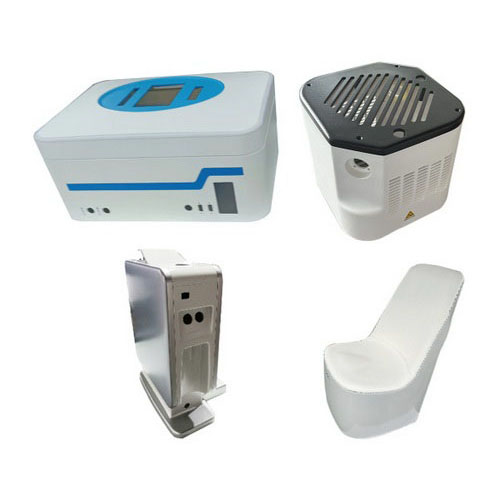
vacuum thermoformed medical device housings precision fit
Vacuum thermoformed housings feature high forming accuracy, customizable surfaces, lightweight structures, and relatively low tooling costs, meeting medical device requirements for durability, assemblability, and appearance consistency.
Description
vacuum thermoformed medical device housings are a type of enclosure and chassis solution manufactured from thermoplastic sheets by vacuum or vacuum-pressure forming processes. The process for vacuum thermoformed medical device housings is suitable for appearance panels and structural parts in small to medium production volumes, and is well suited to enclosure shapes with large sizes or complex surfaces.
Key forming process points for vacuum thermoformed medical device housings:
- Material preparation: Ensure sheets are free of scratches and contamination and implement batch control; apply lamination or backing when necessary to increase rigidity or barrier performance.
- Heating and forming: Set uniform heating profiles and pre-stretch parameters according to material characteristics; use vacuum or combined vacuum‑pressure forming to ensure geometric detail reproduction and control wall thickness distribution.
- Mold design: Molds are commonly made from aluminum alloys or steel; optimize venting channels, cooling design and locating mechanisms. Mold surface treatment and finish directly affect the appearance of the finished part.
- Cooling and demolding: Control cooling speed to ensure dimensional stability; use protective fixtures during demolding to avoid scratches or deformation.
- Trimming and post-processing: After forming, perform CNC trimming, punching, hot folding, hot pressing or bonding operations, and reserve installation positions for standoffs, inserts and display windows.
Cleanliness and sterilization compatibility:
- Material selection: Choose materials that can withstand specific sterilization methods (such as ethylene oxide, gamma irradiation, or low temperature plasma) according to customer requirements and validate compatibility.
- Production and post-processing environment: It is recommended to complete critical assembly and packaging operations in clean or controlled environments to reduce contamination risk and ensure surface cleanliness.
- Surface chemical resistance: Consider the effects of disinfectants, cleaning agents and disinfection frequency on surface coatings and materials, and conduct resistance testing.