
 English
  Français
  Tiếng Việt
  Italiano
  Nederlands
  Türkçe
  Svenska
  Polski
  Română
  Latviešu
  한국어
한국어  Русский
  Español
  Deutsch
  Українська
  Português
  العربية
  Indonesian
  Čeština
  Suomi
Suomi  Eesti
Eesti  Български
  Dansk
Dansk  Lietuvių
  Bokmål
  Slovenčina
  Slovenščina
  Ελληνικά
  Magyar
  עברית
עברית 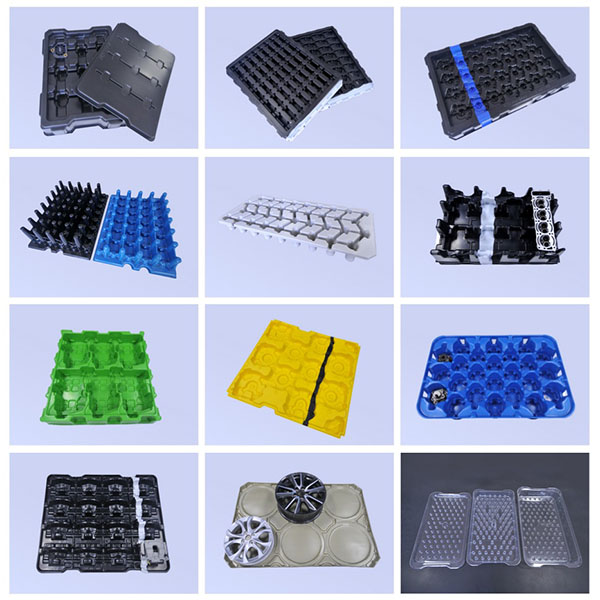
vacuum-formed packaging for automotive parts solutions
vacuum-formed packaging for automotive parts are specialized packaging liners and trays manufactured from thermoplastic sheets using vacuum forming or thermoforming processes, designed to provide precise support, shock protection, and efficient assembly positioning for automotive parts.
Description
vacuum-formed packaging combines lightweight construction, high customizability, and good surface finish, and is widely used for transport and storage protection of engine parts, chassis components, lighting assemblies, electronic modules, and similar items.
Key forming process points:
- Material preparation: ensure sheets are flat and free of contamination; perform cutting or lamination pretreatment when necessary to guarantee forming consistency.
- Heating and forming: set uniform heating profiles according to material and thickness, and use vacuum or combined vacuum-pressure forming to improve forming accuracy and detail reproduction.
- Molds and positioning: use aluminum or steel molds and design appropriate locating, venting, and cooling structures to ensure dimensional stability in repeated forming.
- Trimming and post-processing: perform CNC trimming, punching, bending, bonding, or install locating elements after forming to meet assembly and interface requirements.
- Batch stability control: establish forming parameter templates and monitor temperature, vacuum level, and cooling time to ensure consistency in large-volume production.
Advantages and features:
- Strong protection: targeted cushioning and precise fit effectively reduce damage during transport and assembly.
- Cost and lead-time advantages: compared with injection molding or compression molding, vacuum-formed molds require lower investment and enable faster sample and small-batch delivery.
- High customizability: styles and functions can be rapidly customized according to part geometry, process requirements, and brand colors.
- Lightweight and recyclable options: materials are lightweight, and recyclable materials can be selected to reduce environmental impact.
- Automation compatibility: trays and liners can be designed for robotic handling and vision-recognition-friendly operation.
Typical application scenarios for vacuum-formed packaging:
- Engine and powertrain parts: liners for transport protection of engine blocks, crankshafts, connecting rods, etc.
- Chassis and suspension components: anti-vibration trays for control arms, brackets, and shock absorber parts.
- Lighting and trim components: surface protection and positioning for headlamp assemblies, grilles, and instrument panels.
- Electronic modules and sensors: antistatic and cushioning liners for ECUs, sensors, and camera modules (depending on material selection).
- Supply chain turnover and assembly lines: reusable turnover liners for parts that support automated feeding and sorting.