
 English
  Français
  Tiếng Việt
  Italiano
  Nederlands
  Türkçe
  Svenska
  Polski
  Română
  Latviešu
  한국어
한국어  Русский
  Español
  Deutsch
  Українська
  Português
  العربية
  Indonesian
  Čeština
  Suomi
Suomi  Eesti
Eesti  Български
  Dansk
Dansk  Lietuvių
  Bokmål
  Slovenčina
  Slovenščina
  Ελληνικά
  Magyar
  עברית
עברית 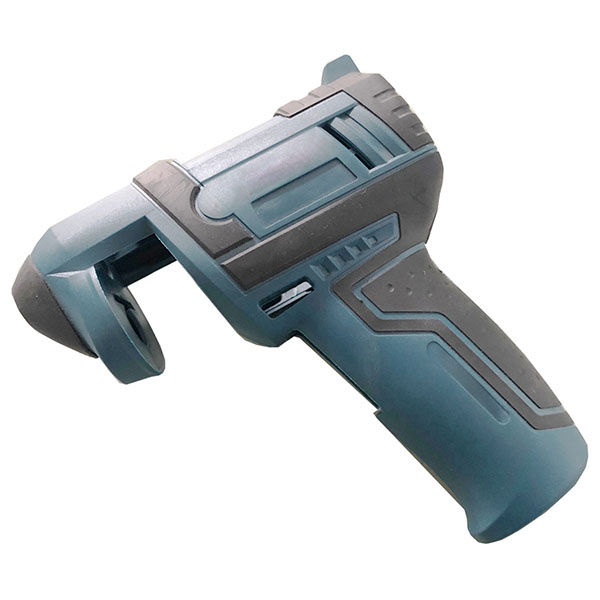
two-shot injection molding of power tool housings OEM
Two‑shot injection molding of power tool housings is an advanced injection molding technology that employs two injection steps (or molding of two materials in a single cycle) within the same mold or on a continuous mold platen.
Two‑shot injection molding process can achieve a two-color appearance or a combination of functional materials (for example, integration of a hard shell and soft touch points), significantly improving product feel, slip resistance, sealing, and assembly efficiency. It is commonly used for housings and grip components of handheld power tools such as electric drills, saws, and impact wrenches.
Process principle of Two‑shot injection molding:
Two‑shot injection molding injects different materials or different-colored plastics into different areas of the same part in two independent injection steps (or by a two-cavity parallel mold system). The first step injects the substrate (usually a structurally strong rigid plastic) and positions it within the mold; subsequently, the mold uses rotation, switching, or transfer mechanisms to position the workpiece for the second injection, where the second material (such as soft TPE/TPU) is injected to achieve overmolding, encapsulation, or bonding. The key factors are the positioning accuracy of the two injections, bondline/interface design, and compatibility between materials.
Mold and equipment requirements:
- Mold structure: Must provide two-shot capability or a two-stage injection positioning mechanism (rotary mold, linear transfer mold, or index mold); mold cavities, parting lines, and transfer positioning must be precise, and the design must accommodate demolding, cooling, and secondary injection channels.
- Gates and runners: Reasonably select gate types and locations, and use a hot-runner system when necessary to ensure good flow and consistent appearance for the second injection.
- Cooling and temperature control: To ensure consistency and dimensional stability between the two injections, cooling circuits must be precisely designed and stable mold temperature control equipment provided.
- Injection molding machine requirements: Use specialized injection molding machines with two-material feeding or two-color/two-step control (or two linked machines), and provide high-precision mold transfer and positioning control.
Process flow and key parameters:
- Mold preparation and first shot: Clean the cavity, inject the first material, and control injection speed, holding pressure, and cooling to ensure dimensional and surface quality.
- Transfer and positioning: Use rotary or transfer mechanisms to position the injected part for the second shot, ensuring positioning accuracy and clamping force.
- Second shot: Inject the second material, reasonably control melt temperature, injection rate, and holding pressure so that it forms good bonding and complete encapsulation with the substrate at the interface.
- Cooling and demolding: Set cooling time according to material characteristics to avoid warpage or interface delamination caused by internal stresses.
- Post-processing and inspection: Deburr, trim, or perform secondary operations, and inspect interface bonding, appearance, and dimensions.
Key parameters: injection rate, injection pressure, holding time, mold temperature, melt temperature, transfer/positioning accuracy, and cooling time.
Advantages and considerations:
- Advantages: Achieves integrated appearance and functional combination, improves assembly efficiency, reduces secondary assembly costs, and enhances ergonomics and grip comfort.
- Considerations: Material compatibility, interface design, transfer/positioning accuracy, and mold cooling all significantly affect yield; for high-volume production, trade-offs among hot-runner systems, mold investment, and maintenance costs must be considered.
Typical applications of Two‑shot injection molding:
- Power tool housings and grips: hard-shell structures combined with soft grips or soft touch points.
- Switches and buttons: integrated molding of rigid structures with soft-touch control areas.
- Other handheld devices: housings that require both durability and comfortable grip.