
 English
  Français
  Tiếng Việt
  Italiano
  Nederlands
  Türkçe
  Svenska
  Polski
  Română
  Latviešu
  한국어
한국어  Русский
  Español
  Deutsch
  Українська
  Português
  العربية
  Indonesian
  Čeština
  Suomi
Suomi  Eesti
Eesti  Български
  Dansk
Dansk  Lietuvių
  Bokmål
  Slovenčina
  Slovenščina
  Ελληνικά
  Magyar
  עברית
עברית 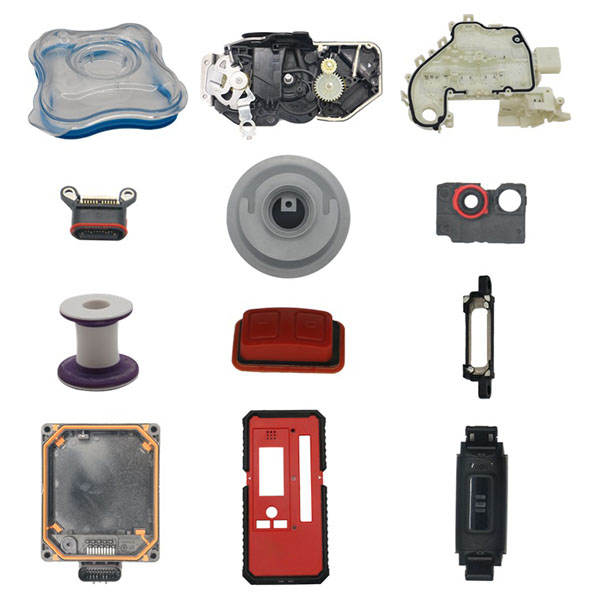
two-color injection-molded silicone products for grips
Two-color injection-molded silicone products employ two-color, two-shot injection molding processes on liquid silicone rubber (LSR) or thermoset/thermoplastic silicone materials to realize integrated molding of two materials with different hardnesses, colors, or functionalities.
Description
The Two-color injection-molded silicone products process can achieve soft-hard combination, color splicing, and functional zone segmentation on a single part, and is widely used in consumer and industrial items that require a comfortable touch, sealing, anti-slip properties, or aesthetic zoning, such as handles, buttons, sealing rings, medical device components, and electronic appearance parts.
Typical applications:
- Handles and grip parts: integration of soft grip areas with a rigid support core to enhance holding comfort and durability.
- Keys and panels: two-color, clearly two-toned key surfaces that balance tactile feel and visual identification.
- Seals and valve parts: create different hardness zones on sealing rings or valve seats to meet sealing and elasticity requirements.
- Children’s and medical products: use non-toxic silicone to provide comfortable surfaces and structured support.
- Electronic decorative parts and sleeves: weather-resistant, anti-yellowing appearance parts with color segmentation.
- Compression cushioning and anti-slip parts: combine energy absorption and abrasion resistance functions to enhance protection.
Common materials and characteristics of Two-color injection-molded silicone products:
- LSR (liquid silicone rubber): good flowability, capable of high-precision textures and details, resistant to high and low temperatures, and non-toxic.
- TPE, TPV modified silicones (co-injected with silicone or in composite structures): used to achieve different hardness levels or cost optimization.
- Different hardness pairings: combinations of a hard core (such as higher-hardness silicone or engineering plastics) with soft-skin silicone to balance structural support and comfortable touch.
- Colorants and additives: use colorants and functional fillers that comply with ROHS, food-grade, and medical-grade standards to meet weather resistance, antibacterial, or flame-retardant requirements.
Injection molding process and production flow:
- Material preparation: prepare LSR or silicone material according to the formulation, control mixing ratios, degassing and deaeration, and add color in batches if necessary.
- Mold and machine preparation: use two-color injection systems, rotary tables, dual-shot nozzles molds, or 2K injection equipment, and select appropriate temperature control and metering systems according to the process.
- First injection and molding: form the first material first (usually the substrate or hard core), completing curing or positioning.
- Second injection: inject the second material into the first part while it is still in the mold or after positioning to achieve co-flow or overmolded structures.
- Post-curing and cooling: perform necessary vulcanization or post-curing treatment according to the silicone type to ensure material properties.
- Secondary processing and inspection: trimming, deburring, cleaning, functional testing and appearance inspection; perform laser marking or pad printing when necessary.
Surface treatment and post-processing:
- Mold texture and matte/gloss control: achieve different tactile and visual effects through mold surface treatments.
- Coloring and printing: two-color molded parts can reduce subsequent painting processes; support pad printing, inkjet, or laser marking when necessary.
- Coatings and antibacterial treatments: functional surface coatings can be added (for example, anti-stick, anti-fingerprint or antibacterial coatings).