
 English
  Français
  Tiếng Việt
  Italiano
  Nederlands
  Türkçe
  Svenska
  Polski
  Română
  Latviešu
  한국어
한국어  Русский
  Español
  Deutsch
  Українська
  Português
  العربية
  Indonesian
  Čeština
  Suomi
Suomi  Eesti
Eesti  Български
  Dansk
Dansk  Lietuvių
  Bokmål
  Slovenčina
  Slovenščina
  Ελληνικά
  Magyar
  עברית
עברית 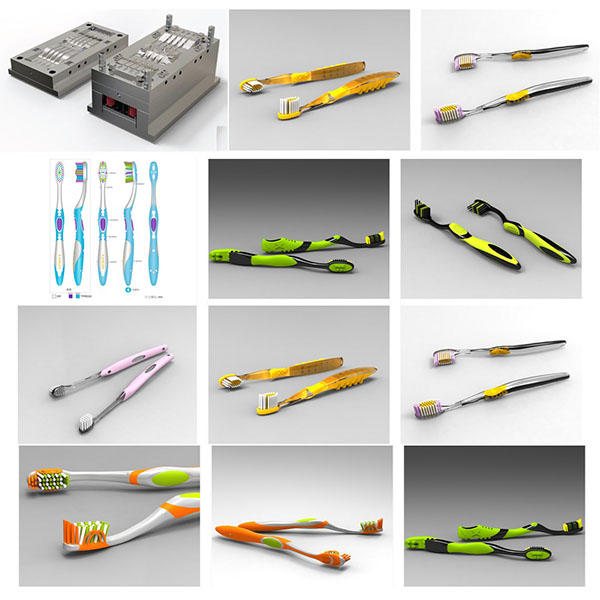
toothbrush injection mold for durable ergonomic designs
Toothbrush injection molds emphasize dimensional accuracy, ergonomic fit, surface texture, and durability, while also addressing hygiene and assembly convenience, and accommodate a variety of engineering plastics and elastomeric materials.
Description
Toothbrush injection molds are used for efficient mass production of various toothbrush components, including handles, heads, necks, and assemblies, and are widely applied in the manufacturing of disposable toothbrushes, household electric toothbrush accessories, and high-end personal care products.
Typical applications of toothbrush injection molds:
- Handles, heads, and neck components for manual toothbrushes.
- Replaceable brush heads (including clips and locating features) and handle housings for electric toothbrushes.
- Children’s and adults’ toothbrushes with anti-slip features, soft TPE overmolds, or special shapes.
- Multifunctional toothbrush accessories such as massage heads, tongue cleaners, or travel carry items.
- Structural components and sealing interfaces integrating ultrasonic or vibration functions.
Product features and customer value:
- High dimensional and fit precision: ensures consistency of bristle holders, clips, and locating features, improving assembly yield and product reliability.
- Ergonomic optimization: supports complex contours and anti-slip textures to enhance grip and user comfort.
- Surface quality and aesthetics: supports mirror finishes, matte or fine texture treatments to meet appearance, printing, and branding requirements.
- Multi-material integration: enables one-piece designs combining rigid substrates with soft TPE overmolds, reducing secondary assembly.
- High throughput and low unit cost: multi-cavity and optimized runner designs enable short cycles and high yields, suitable for large-scale production.
Injection molding process and mass-production flow:
- Trial molding and parameter verification: initial trial molding should verify balanced filling, holding performance, bristle seat formation, and warpage behavior, and adjust gate locations and wall thickness distribution as needed.
- Multi-material process control: set appropriate injection sequences, holding and cooling cycles to ensure bonding strength and appearance consistency for two-shot or co-injection processes.
- Process locking: determine injection speed, holding-pressure profile, mold temperature, and ejection rhythm; establish standard operating procedures (SOPs) and record key control points.
- Mass production and online inspection: use SPC to monitor critical dimensions, combined with online vision inspection systems and automatic rejection equipment to ensure appearance and functional stability.
- Post-processing and assembly preparation: perform deburring, bristle insertion/tufting or heat-staking operations, and conduct sampling tests for pull strength, torque, or durability.