
 English
  Français
  Tiếng Việt
  Italiano
  Nederlands
  Türkçe
  Svenska
  Polski
  Română
  Latviešu
  한국어
한국어  Русский
  Español
  Deutsch
  Українська
  Português
  العربية
  Indonesian
  Čeština
  Suomi
Suomi  Eesti
Eesti  Български
  Dansk
Dansk  Lietuvių
  Bokmål
  Slovenčina
  Slovenščina
  Ελληνικά
  Magyar
  עברית
עברית 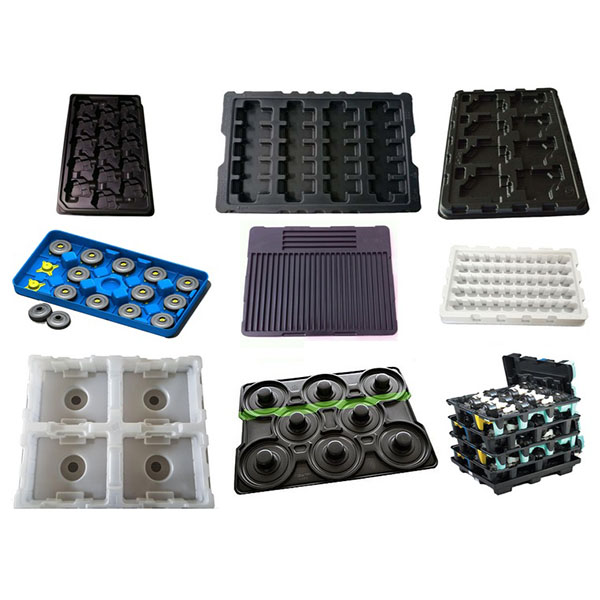
thick-sheet vacuum-formed tray for heavy-duty parts
thick-sheet vacuum-formed trays are manufactured from thick-gauge thermoplastic sheets using vacuum forming processes and are specifically designed to support heavier workpieces and provide stable support and protection.
Description
Compared with thin-sheet trays, thick-sheet trays offer higher rigidity, better impact resistance, and greater durability, making them suitable for transportation, storage, assembly stations, and protection of heavy components.
Applicable materials and specifications:
- Common base materials: thick-gauge thermoplastic sheets such as high-rigidity PET, HIPS, ABS, PVC, PP, etc.; select the appropriate material based on strength, toughness, and chemical resistance requirements.
- Thickness range: common thicknesses vary by application and can be selected in approximately the 1.5mm–6mm range or thicker; specific thicknesses can be customized according to load-bearing and forming requirements.
- Surface treatments: available in glossy, matte, or textured finishes; supports post-treatments such as painting, screen printing, and UV coating to meet aesthetic or marking needs.
- Reinforcement options: stiffness and load capacity can be increased through ribbing designs or localized thickening, or by using composite laminates to improve rigidity and impact resistance.
Key forming process points:
- Material preheating and forming parameters: thick sheets require appropriate heating temperatures and uniform dwell to ensure proper forming fill and detail reproduction; forming pressure and vacuum level must be optimized to avoid weak spots or stretch cracking.
- Molds and locating: use aluminum or steel molds for precise forming; design locating features and edges according to tray size and stacking requirements to ensure dimensional consistency and stackability.
- Trimming and reinforcement: perform CNC trimming or die-cutting after forming; apply hot folding or bonding reinforcement where necessary to meet functional requirements.
- Batch stability: to ensure consistency in large-volume production, establish forming parameter templates and implement process control (temperature, vacuum, cooling time, etc.).
Advantages and features:
- High load-bearing capacity: thick materials and reinforced structures provide good rigidity and load-bearing performance, suitable for heavy or large-item protection.
- Impact resistance and durability: superior impact resistance and fatigue performance, suitable for repeated reuse and circulation.
- Cost and lead-time advantages: compared with metal pallets or injection-molded structural parts, thick-sheet vacuum-formed trays require lower mold investment and have shorter sample and small-to-medium batch lead times.
- High customizability: easily customizable by product shape, color, marking, and functional requirements.
- Automation-friendly: can be designed to be compatible with automated feeding, machine vision recognition, and robotic picking.
Typical application scenarios for thick-sheet vacuum-formed trays:
- Industrial parts and mechanical components: liners and protective trays for heavy components such as engine parts, pump housings, and gearbox housings.
- Automotive manufacturing: transport and assembly protection for headlamp assemblies, instrument clusters, and metal cavity parts.
- Home appliances and electronics: transport protection for large appliance panels, compressors, transformers, etc.
- Warehousing and logistics: reusable turnover trays compatible with automated storage and handling systems.
- Display and packaging: display liners and custom packaging solutions for heavy products.