
 English
  Français
  Tiếng Việt
  Italiano
  Nederlands
  Türkçe
  Svenska
  Polski
  Română
  Latviešu
  한국어
한국어  Русский
  Español
  Deutsch
  Українська
  Português
  العربية
  Indonesian
  Čeština
  Suomi
Suomi  Eesti
Eesti  Български
  Dansk
Dansk  Lietuvių
  Bokmål
  Slovenčina
  Slovenščina
  Ελληνικά
  Magyar
  עברית
עברית 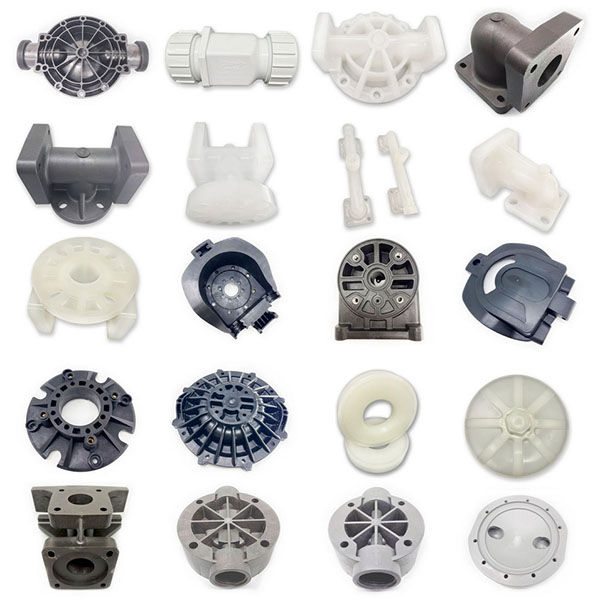
thermoplastic injection-molded pump components with seals
Thermoplastic injection-molded pump components are produced by injection molding engineering plastics into key parts such as pump bodies, impellers, bearing housings, and seal seats, and are suitable for various pump applications including water pumps, chemical pumps, fuel pumps, and hydraulic pumps.
Description
Thermoplastic materials offer excellent chemical resistance, dimensional stability, and mechanical toughness, meeting the needs of pumps for corrosion resistance, wear resistance, resistance to temperature changes, and lightweighting.
Typical applications of thermoplastic injection-molded parts:
- Pump housings and bodies: structural components that withstand internal pressure, fluid erosion, and external mounting stresses.
- Impellers and blades: key rotating components that affect flow and efficiency, requiring good hydrodynamic characteristics and wear resistance.
- Bearing housings and guide components: structural elements that ensure rotor concentricity and operational stability.
- Seal seats and valve seats: mate with mechanical seals or elastomeric seals to achieve reliable fluid isolation.
- Connectors and mounting flanges: provide reliable interfaces to piping, drive ends, or assembly components.
Common materials and characteristics:
- Polypropylene (PP): chemically resistant, low cost, suitable for acidic, alkaline, or general corrosive media.
- Polyamide (PA6/PA66, glass-fiber reinforced): high mechanical strength and good wear resistance, suitable for impellers and structural parts.
- Modified polyvinylidene fluoride or fluorinated materials (FEP/PFA-modified grades): excellent high-temperature and chemical resistance for special chemical media scenarios.
- Polyoxymethylene (POM): low friction coefficient and dimensional stability, suitable for sliding fits and gear-like parts.
- Thermoplastic polyurethane (TPU): used for elastic sealing parts or vibration-damping areas, combining elasticity and wear resistance.
- Reinforcements and modifications: glass fiber, mineral fillers, wear-resistant additives, or UV/flame-retardant agents optimized by formulation as required.
Processing and production flow:
- Raw material and color preparation: weigh and mix masterbatch, fillers, and additives according to formulation; dry treatment may be performed as necessary to avoid defects caused by moisture absorption.
- Injection molding: set injection temperature, holding/packing profile, and cooling time according to material characteristics; use appropriate clamp force and injection speed to ensure mold filling quality.
- Secondary machining: machine critical mating surfaces, drill holes, or tap threads to meet assembly and tolerance requirements.
- Assembly and sealing: install bearings, mechanical seals, or elastomeric parts, and use adhesives or thermal assembly methods as needed.
- Inspection and packaging: after completing functional tests, pressure tests, and appearance checks per inspection standards, perform cleaning and protective packaging.
Surface treatments and post-processing for thermoplastic injection-molded pump components:
- Surface hardening: sandblasting, polishing, or chemical treatments to improve wear resistance and appearance.
- Coatings and anti-corrosion treatments: apply corrosion-resistant coatings or low-friction coatings according to the media and operating environment.
- Identification and traceability: use laser marking, silk-screen printing, or nameplates to label part numbers and batch information.