
 English
  Français
  Tiếng Việt
  Italiano
  Nederlands
  Türkçe
  Svenska
  Polski
  Română
  Latviešu
  한국어
한국어  Русский
  Español
  Deutsch
  Українська
  Português
  العربية
  Indonesian
  Čeština
  Suomi
Suomi  Eesti
Eesti  Български
  Dansk
Dansk  Lietuvių
  Bokmål
  Slovenčina
  Slovenščina
  Ελληνικά
  Magyar
  עברית
עברית 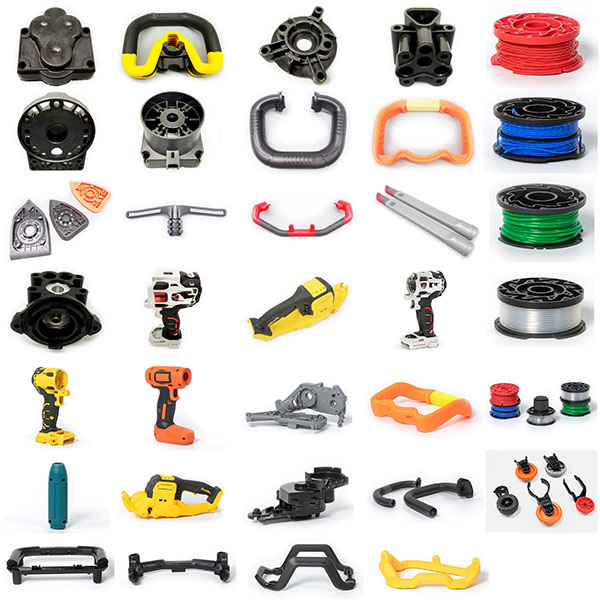
thermoplastic injection-molded power tool components
Thermoplastic injection-molded power tool components are manufactured from engineering thermoplastic materials through injection molding and necessary secondary processing techniques, and are widely used as structural and housing components in drills, saws, angle grinders, impact wrenches, and other portable and handheld power tools.
Description
Thermoplastic injection-molded power tool components combine high molding efficiency, good processing consistency, and the ability to realize complex integrated structures, meeting the stringent requirements of power tools for durability, safety, electrical insulation, and mass production.
Typical applications:
- Enclosures and handles: carry internal modules and provide ergonomic grip shapes, while accommodating heat dissipation and anti-slip performance.
- Gearbox covers and transmission structural parts: precision structures used to bear torque, locate bearings, and mate with metal components.
- Insulation and isolation parts: insulating supports, wire ducts, and isolation gaskets for motors and electrical components.
- Switches and key assemblies: actuating components that withstand repeated pressing, provide consistent tactile feel, and meet dust- and water-resistant requirements.
- Guiding and fastening parts: snaps, studs, guide posts, and brackets that ensure assembly accuracy and vibration-resistance reliability.
- Thermal management and ventilation structures: ventilation grilles and air ducts that work with internal cooling to optimize heat management.
- Protective and cushioning components: covers, protective caps, and energy-absorbing pads used to protect the tool and the user.
Design considerations and engineering concerns:
- Structural strength and wall thickness control: reasonably distribute wall thickness and ribs to avoid stress concentration and warpage.
- Assembly and load-direction design: the design of snaps, threads, and flanges should consider assembly sequence, load directions, and fatigue life.
- Thermal management and ventilation paths: reserve cooling channels and thermal conduction paths in high-power tools, and use thermally conductive materials or heatsink interfaces when necessary.
- Electrical insulation and safety clearances: design insulation gaps and creepage distances according to voltage levels, and reserve provisions for grounding/shielding.
- Vibration and shock resistance: material selection and structural design should pass vibration and shock tests to ensure long-term reliability.
- Post-processing and mating surfaces: reserve machining allowances for critical mating surfaces or use inserts to ensure assembly tolerances and longevity.
Injection molding process and production flow:
- Raw material preparation: mix masterbatch, reinforcement fibers, flame retardants and functional additives according to the formulation; perform drying if necessary.
- Injection molding: set appropriate injection temperatures, holding/packing profiles and cooling times; use suitable mold temperature control and ejection mechanisms to improve molding consistency.
- In-mold or post-mold insert assembly: when metal threaded inserts or conductive inserts are required, in-mold insertion or thermal insertion processes can be used.
- Secondary processing: milling, tapping, deburring, or post-processes such as thermal or ultrasonic welding to meet assembly requirements.
- Surface treatment: painting, sandblasting, textured mold surface formation, or soft-touch coating to improve feel and durability.
- Assembly and testing: after assembling electronic and mechanical components, perform functional tests, durability tests and safety validations.