
 English
  Français
  Tiếng Việt
  Italiano
  Nederlands
  Türkçe
  Svenska
  Polski
  Română
  Latviešu
  한국어
한국어  Русский
  Español
  Deutsch
  Українська
  Português
  العربية
  Indonesian
  Čeština
  Suomi
Suomi  Eesti
Eesti  Български
  Dansk
Dansk  Lietuvių
  Bokmål
  Slovenčina
  Slovenščina
  Ελληνικά
  Magyar
  עברית
עברית 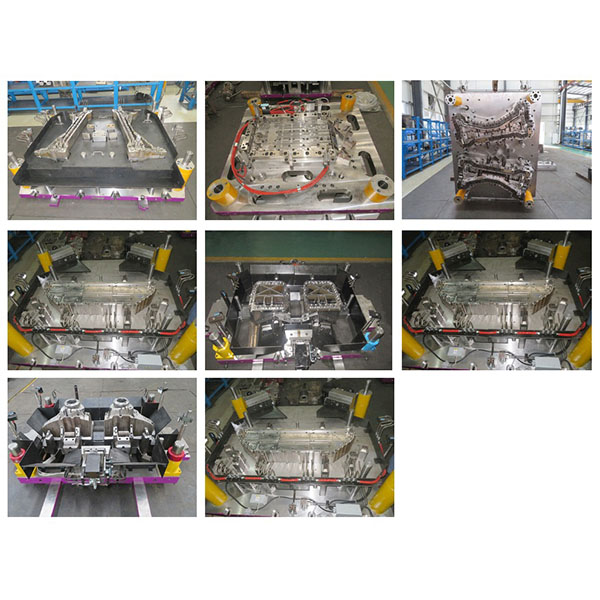
stamping dies are used in custom processing machinery
Stamping dies are used on presses or specialized processing machinery to perform a series of forming operations on sheet metal, including blanking, piercing, bending, deep drawing, flanging and other forming processes.
Description
Stamping dies developed for custom processing machinery can be specifically designed and manufactured according to the customer’s process requirements and production volume targets, delivering high-precision, highly stable, and high-efficiency mass production capabilities that meet the needs of multiple stages from prototyping to mass production.
Structure and materials of stamping dies:
- Die structure: depending on process requirements, dies can be designed as single-station dies, compound dies, progressive dies, continuous dies, or multi‑cavity dies, and may include modules such as the upper die, lower die, guide systems, return and ejection mechanisms, and continuous feeding devices.
- Common die materials: tool steels (e.g., SKD11, H13, DC53), high-strength alloy steels, and quenched-and-tempered structural steels; for areas with high wear requirements, surface treatments such as carburizing, nitriding, or coatings are used to extend service life.
- Accessories and standard parts: guide posts, guide bushings, tie rods, springs, shims, locating pins, etc., are selected based on load and usage frequency and are strictly inspected.
Process capabilities and functions of stamping dies:
- Supported operations: blanking, dropping, piercing, bending, deep drawing, flanging, forming, toothed cutting, chamfering, trimming, compound and progressive combinations of these operations.
- Compatibility: can be integrated with automatic feeding, robotic loading/unloading, inspection and sorting equipment, and adapted to single presses or automated production line retrofits.
- Capacity and precision: can be designed to meet customer requirements for either high-speed continuous stamping or medium-to-low-speed high-precision production.
Main performance and features:
- High stability: precise fits and heat treatment processes ensure dimensional stability and wear resistance of the die during mass production.
- High efficiency: optimized process layout and smooth material flow reduce cycle times and increase output.
- Maintainability: modular design facilitates maintenance, replacement of wear parts, and quick die repair, minimizing downtime.
- Cost advantage: in medium-to-large volume production, die investment is amortized, significantly reducing unit manufacturing costs.
- High customizability: materials selection, die structure, part ejection methods, and surface treatments can be customized according to part function and production environment.
Typical applications:
- Automotive industry: body structural components, brackets, hangers, connectors, etc.
- Household appliances and white goods: panels, support parts, internal structural components.
- Electronic products: shields, enclosures, terminals and connectors.
- Industrial equipment: control cabinet panels, machine guards, mounting brackets.
- Medical and precision instruments: non-standard metal components, supports and structural assemblies.