
 English
  Français
  Tiếng Việt
  Italiano
  Nederlands
  Türkçe
  Svenska
  Polski
  Română
  Latviešu
  한국어
한국어  Русский
  Español
  Deutsch
  Українська
  Português
  العربية
  Indonesian
  Čeština
  Suomi
Suomi  Eesti
Eesti  Български
  Dansk
Dansk  Lietuvių
  Bokmål
  Slovenčina
  Slovenščina
  Ελληνικά
  Magyar
  עברית
עברית 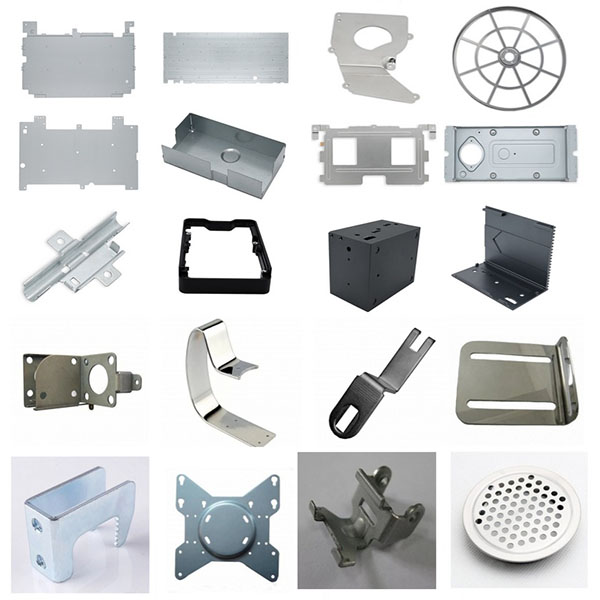
stamped parts for precision custom metal components
Stamped parts are metal components mass-produced by performing blanking, bending, deep drawing, and forming operations on thin sheet metal using presses and dies, offering high-speed, stable, and repeatable processing capabilities.
Description
Stamping is suitable for medium-to-large volume production; it can significantly reduce unit cost while ensuring dimensional accuracy and surface quality, and is widely used for structural parts, housings, brackets, connectors, and various functional components.
Materials and processes for stamped parts:
- Common materials: cold-rolled steel, hot-rolled steel, galvanized steel, stainless steel (e.g., 304/316), aluminum alloys (e.g., 5052/6061), copper and its alloys, etc.
- Process types: blanking, piercing, bending, deep drawing, flanging, forming and trimming, progressive/compound stamping.
- Surface treatments: phosphating, electroplating (zinc/nickel/tin plating), painting, powder coating, anodizing (for aluminum), passivation, etc., to meet corrosion resistance and decorative requirements.
Key performance and features:
- High efficiency: suitable for high-speed continuous production with short cycle times and high output.
- High consistency: dies ensure repeatable accuracy in part dimensions and shapes, resulting in consistent finished products.
- Cost advantage: die investment is amortized over large volumes, yielding low unit costs for mass production.
- Versatility: enables multi-step integrated processing to reduce assembly and secondary operations.
- Customizability: materials, thicknesses, tolerances, and surface treatments can be customized according to customer drawings and functional requirements.
Typical applications:
- Automotive parts: body structural components, brackets, covers, fasteners, etc.
- Household appliances and white goods: exterior panels, support structures, rails, etc.
- Electronic products: enclosures, shields, terminals and connectors.
- Industrial equipment: control cabinet panels, machine tool guards, mounting brackets.
- Medical and precision equipment: non-standard metal parts, supports and structural assemblies.