
 English
  Français
  Tiếng Việt
  Italiano
  Nederlands
  Türkçe
  Svenska
  Polski
  Română
  Latviešu
  한국어
한국어  Русский
  Español
  Deutsch
  Українська
  Português
  العربية
  Indonesian
  Čeština
  Suomi
Suomi  Eesti
Eesti  Български
  Dansk
Dansk  Lietuvių
  Bokmål
  Slovenčina
  Slovenščina
  Ελληνικά
  Magyar
  עברית
עברית 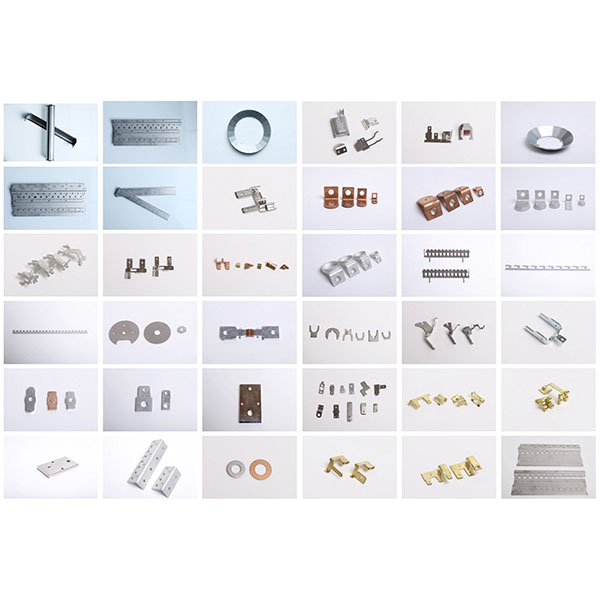
stamped metal parts precision tooling and die solutions
Stamped metal parts are industrial products produced by stamping metal sheets into various structural and functional components, and are widely used in automotive, home appliances, electronics, hardware tools, construction, and industrial equipment industries.
Stamped metal parts offer advantages such as high processing efficiency, good dimensional consistency, low unit cost, and suitability for mass production, meeting manufacturing needs from simple flat parts to complex three-dimensional formed components.
Main processes and capabilities for stamped metal parts:
- Blanking and feeding: Using presses and blanking dies for high-speed blanking to obtain dimensionally stable blanks that serve as the basis for subsequent forming operations.
- Deep drawing and forming: Supporting single- or multi-stage deep drawing, flanging, and flange-drawing processes to manufacture parts with depth and complex contours.
- Bending and folding: Utilizing CNC press brakes or dedicated tooling across stations to perform precise bends, ensuring angle accuracy and springback control within acceptable ranges.
- Shaping and trimming: Ensuring mating surfaces and assembly dimensions via reshaping, trimming, punching, and cutoff secondary operations.
- Progressive and transfer dies: Providing integrated progressive die and transfer die solutions to achieve multi-operation linked processing for improved productivity and consistency.
- Secondary operations: Supplying complementary services such as spot welding, laser welding, riveting, post-bending machining, and precision cutting to meet assembly and functional requirements.
Materials and thickness range:
Common materials include cold-rolled steel, hot-rolled steel, stainless steel, galvanized sheet, aluminum alloys, copper and copper alloys; specific material grades can be recommended based on customer requirements and formability assessments. Typical sheet thickness generally ranges from 0.3 mm to 6.0 mm (adjustable upward or downward depending on part structure and process); complex or thick parts require confirmation of material and die solutions during engineering review.
Quality and tolerance control for stamped metal parts:
- Dimensions and tolerances: Use precision die manufacturing, stable feeding, and automatic positioning systems to ensure key dimensional tolerances and interchangeability.
- Surface quality: Optimize cutting edges and clearances, and choose appropriate lubrication and protection measures to reduce burrs, scratches, and impressions, lowering rework rates.
- Inspection and process control: Implement first-article inspection, incoming material inspection, online sampling, and full inspection (as required by orders), and record key process parameters (pressure, stroke, cycle) for traceability.
- Quality systems: Support inspection and documentation management in accordance with customer requirements such as ISO, IATF, or other industry quality management systems.
Die design and tryout services:
- Die design and manufacture: Provide integrated services from part development, strip layout design, and die structure design to die manufacturing, supporting finite element simulation and process validation.
- Tryout and first-article confirmation: Deliver a first-article report after tryout, including key dimensions, appearance, burrs, forming defects, and improvement suggestions; optimize dies or process parameters based on tryout results.
- Maintenance and spare parts: Offer die maintenance, repair services, and supply of consumable spare parts; support scheduled maintenance to extend die life and reduce downtime.
Surface treatment and downstream processes:
According to parts’ corrosion resistance and decorative requirements, provide surface treatments such as phosphating, painting, electroplating, e-coating, powder coating, and anodizing (for aluminum parts), as well as necessary heat treatment or localized annealing processes to ensure performance and appearance meet customer requirements.