
 English
  Français
  Tiếng Việt
  Italiano
  Nederlands
  Türkçe
  Svenska
  Polski
  Română
  Latviešu
  한국어
한국어  Русский
  Español
  Deutsch
  Українська
  Português
  العربية
  Indonesian
  Čeština
  Suomi
Suomi  Eesti
Eesti  Български
  Dansk
Dansk  Lietuvių
  Bokmål
  Slovenčina
  Slovenščina
  Ελληνικά
  Magyar
  עברית
עברית 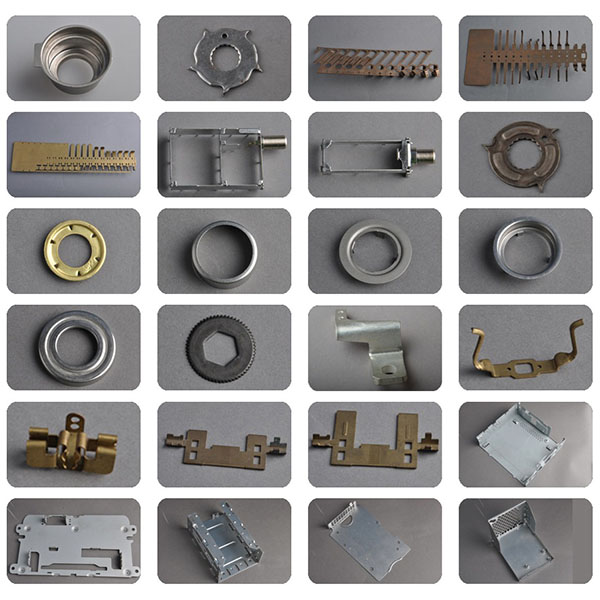
stamped electronic equipment parts for precision use
Stamped electronic equipment parts are functional and structural components manufactured by performing blanking, piercing, bending, forming, stamping/reshaping, and other operations on sheet metal or strip material using presses and dedicated dies.
Description
Stamping is suitable for medium-to-large volume production, enabling efficient, stable, and low-cost manufacturing while ensuring dimensional accuracy, assembly fit, and surface quality. Common products include enclosures, shielding covers, grounding plates, terminals, heatsinks, mounting brackets, rails, and various connecting and mounting components.
Materials and process options for stamped electronic equipment parts:
- Common materials: cold-rolled steel, galvanized steel, stainless steel (e.g., 304, 301), copper and copper alloys, brass, aluminum and aluminum alloys (e.g., 5052), and tin- or nickel-plated strip materials. Materials can be selected according to requirements for electrical conductivity, thermal conductivity, corrosion resistance, and weldability.
- Process types: blanking, piercing, bending, forming, trimming, drawing, combined stamping-and-bending operations, progressive/compound stamping, and post-stamping forming and bending.
- Surface treatments: plating (tin, nickel, copper), painting, phosphating, oxidation, annealing/leveling, passivation, film coatings, or other anti-corrosion and conductive/anti-oxidation treatments to meet rust prevention, conductive contact, and welding requirements.
Main performance and features of stamped electronic equipment parts:
- Precision and consistency: dies and process controls ensure repeatability of part dimensions and geometric accuracy to meet strict assembly and functional fit requirements.
- Electrical performance and contact reliability: for contact and terminal parts, material selection and surface treatments ensure low contact resistance and long-term stability.
- Thermal management and heat dissipation: material and structural design optimize heatsinks and thermal paths to improve heat dissipation efficiency.
- Weldability and assemblability: designs accommodate welding, brazing, riveting, or screw assembly to facilitate downstream assembly processes.
- High efficiency and low cost: suitable for high-speed continuous stamping; die investment can significantly reduce unit costs in mass production.
- Customizability: customized solutions can be provided for dimensions, tolerances, material surface treatments, elastic contact designs, and vibration-reinforcement measures.
Typical product examples:
- Shielding and grounding parts: electronic shielding covers, EMI/RFI shield plates, grounding spring contacts.
- Connecting and contact parts: terminals, wiring tabs, pin housings, contact springs.
- Structural and enclosure parts: chassis panels, rear covers, support frames, fastening clips.
- Heat-dissipation and thermal structures: small heatsinks, heatsink brackets, and thermal plates.
- Mounting and fastening parts: rails, clips, standoffs, and riveted components.