
 English
  Français
  Tiếng Việt
  Italiano
  Nederlands
  Türkçe
  Svenska
  Polski
  Română
  Latviešu
  한국어
한국어  Русский
  Español
  Deutsch
  Українська
  Português
  العربية
  Indonesian
  Čeština
  Suomi
Suomi  Eesti
Eesti  Български
  Dansk
Dansk  Lietuvių
  Bokmål
  Slovenčina
  Slovenščina
  Ελληνικά
  Magyar
  עברית
עברית 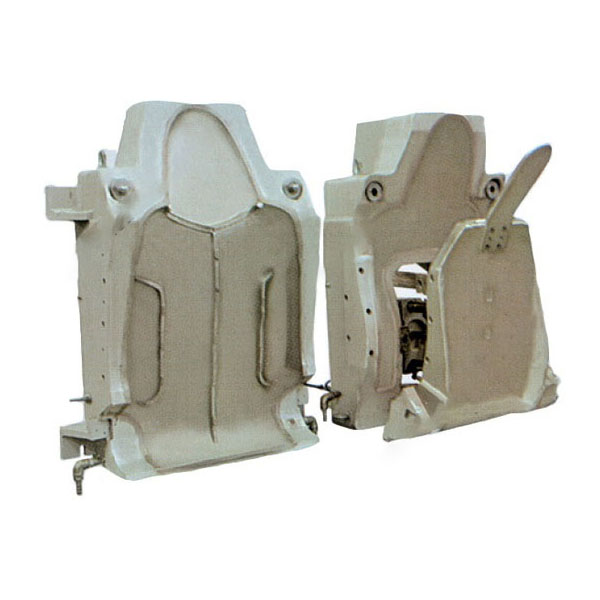
seat-back foam mold for ergonomic comfort and durability
Seat-back foam molds are used for one‑step foam molding of seat backs or seat cushion cores, and are suitable for a wide range of applications including automotive seats, office chairs, household chairs, and aircraft and rail transit seats.
Seat-back foam molds form uniform closed-cell or semi-closed-cell foam structures within the mold cavity through injection foaming, pour‑in foaming, or pour‑casting foaming processes, achieving comfortable support, load distribution, and long-term resilience.
Key features of seat-back foam molds:
1. Foam consistency: Precise cavity and runner design, gate layout, and matching of foaming formulation ensure uniform foam density and closed-cell ratio, providing stable resilience and even load distribution.
2. Ergonomic support: Molds can be shaped and zoned in hardness according to ergonomic design to provide localized support and pressure relief, improving seating comfort and spinal support.
3. Structural and strength optimization: Mold designs incorporating ribs, stiffeners, or composite inserts enhance the backrest’s compression and fatigue resistance while controlling material usage for lightweighting.
4. Temperature control and venting design: Properly configured heating/cooling zones and venting channels optimize cure profiles, reduce bubbles and voids, and improve yield and surface quality.
5. Production efficiency: Supports multi-cavity or multi-stage continuous process layouts and is compatible with automated loading/unloading and downstream assembly, reducing cycle time per part and increasing throughput.
6. Mold life and maintenance: Uses corrosion-resistant alloy steels or cavity materials with surface hardening treatments, and designs replaceable inserts and wear parts to facilitate localized repair and replacement, extending mold service life.
7. Environmental performance and safety: Can be paired with low‑VOC, low‑odor, or non‑toxic foam systems, and flame‑retardant formulations can be selected to meet various market and regulatory requirements.
Applicable materials for seat-back foam molds:
Compatible with a variety of foam systems and hybrid formulations, including polyurethane (PU) foams, thermoplastic foam materials (such as TPU/thermoplastic polyurethane variants), EVA, and other polymer composite foam systems. Materials and formulations can be customized based on comfort, resilience, temperature resistance, flame‑retardant rating, and weatherability requirements.
Customization capabilities:
1. Cavity shape, zoned hardness, and thickness can be customized to samples or CAD drawings, supporting ergonomic contours and functional openings.
2. Supports multi‑cavity and combined‑mold designs to increase capacity or produce multiple specifications simultaneously.
3. Can reserve locations for inserts (such as metal parts, damping structures, hardware interfaces) and assembly locating holes for integrated production.
4. Surface textures, guide grooves, and trim/edge positioning features can be customized to meet appearance and post‑processing requirements.
Application scenarios:
Suitable for passenger car and commercial vehicle seat backs, office chair backs and headrests, household sofa back cushions, aircraft and rail transit seats, medical and rehabilitation seating, and other products that require high levels of support, comfort, and durability.