
 English
  Français
  Tiếng Việt
  Italiano
  Nederlands
  Türkçe
  Svenska
  Polski
  Română
  Latviešu
  한국어
한국어  Русский
  Español
  Deutsch
  Українська
  Português
  العربية
  Indonesian
  Čeština
  Suomi
Suomi  Eesti
Eesti  Български
  Dansk
Dansk  Lietuvių
  Bokmål
  Slovenčina
  Slovenščina
  Ελληνικά
  Magyar
  עברית
עברית 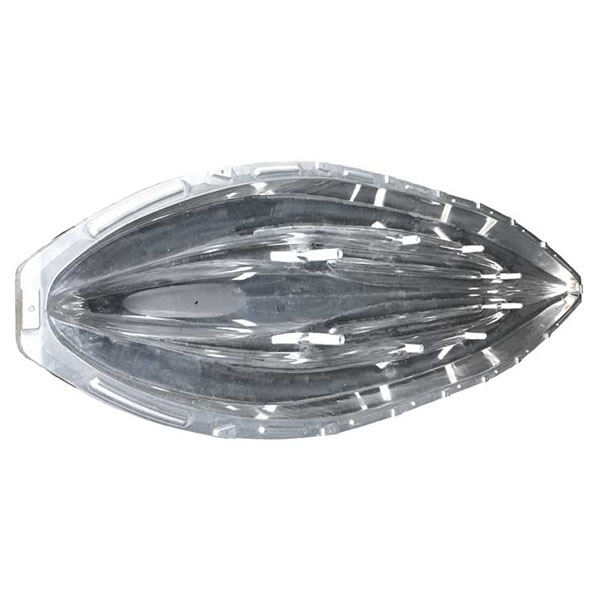
rotomolded kayak mold for efficient mass production
The rotomolded kayak mold is specifically designed for the rotational molding process and is intended for the mass production of high-quality kayak hulls, including canoes, recreational kayaks, and competitive kayak shells.
Description
The rotomolded kayak mold structure enables stable wall-thickness distribution, integrated hollow forming, and excellent surface finish. It supports the insertion and positioning of accessories such as cockpits, grab handles, and drain plugs, making it suitable for kayak manufacturing from small-to-medium batches up to mass production.
Main features of the rotomolded kayak mold:
- Dedicated cavity design: The mold cavities are designed according to the kayak’s overall streamline and structural load points to ensure finished-part dimensional accuracy and service strength.
- Uniform wall-thickness control: By optimizing rotation and heating parameters through cavity geometry and temperature-control systems, uniform wall thickness is achieved, improving structural stability and safety.
- Support for complex details: The mold can reserve or accommodate metal inserts, threaded sockets, drain outlets, and reinforcement ribs to reduce subsequent machining operations.
- Excellent surface treatment: Cavity surfaces can be polished, sandblasted, or textured, directly affecting the finished-part appearance and anti-slip performance.
- Fast thermal response: Manufactured from aluminum or specific alloys, the mold can shorten heating and cooling cycles and improve production efficiency.
- Easy assembly/disassembly and maintenance: The mold uses locating pins and high-strength fasteners for convenient disassembly, adjustment, and repair, reducing downtime.
- High cost-effectiveness: For small-to-medium batch production of kayaks, the mold materials and manufacturing processes strike a balance between service life and cost, offering good overall value.
Structure and manufacturing process:
- Mold parting: Multi-segment or two-piece parting designs are commonly adopted to ensure smooth demolding and product integrity, while reserving venting and feeding locations.
- Material selection: Commonly used aluminum alloys such as 6061 or 6082, or steel selected per requirements with surface reinforcement treatments; choice depends on production volume and durability needs.
- Processing methods: Cavity and mating surfaces are manufactured and finished using CAD/CAM design, CNC machining, wire EDM, precision milling, and surface polishing.
- Temperature-control design: Integrated internal water channels, heating jackets, or temperature-control sleeves can be provided, with temperature control systems to achieve precise mold temperature management.
- Sealing and connections: High-strength bolts, locating pins, and reliable seals are used to ensure accurate mold assembly and prevent material leakage.
- Surface treatment: Molds are polished, anodized, or given other wear-resistant finishes to extend service life and improve finished-part surface quality.
Applicable scope of the rotomolded kayak mold:
- Suitable for producing hulls for various recreational, fishing, rafting, and professional competition kayaks.
- Appropriate for product lines that have higher demands on appearance quality, structural performance, and small-to-medium batch capacity.
- Can be extended to special kayak types with cockpit covers, large hatches, or multifunctional storage compartments.