
 English
  Français
  Tiếng Việt
  Italiano
  Nederlands
  Türkçe
  Svenska
  Polski
  Română
  Latviešu
  한국어
한국어  Русский
  Español
  Deutsch
  Українська
  Português
  العربية
  Indonesian
  Čeština
  Suomi
Suomi  Eesti
Eesti  Български
  Dansk
Dansk  Lietuvių
  Bokmål
  Slovenčina
  Slovenščina
  Ελληνικά
  Magyar
  עברית
עברית 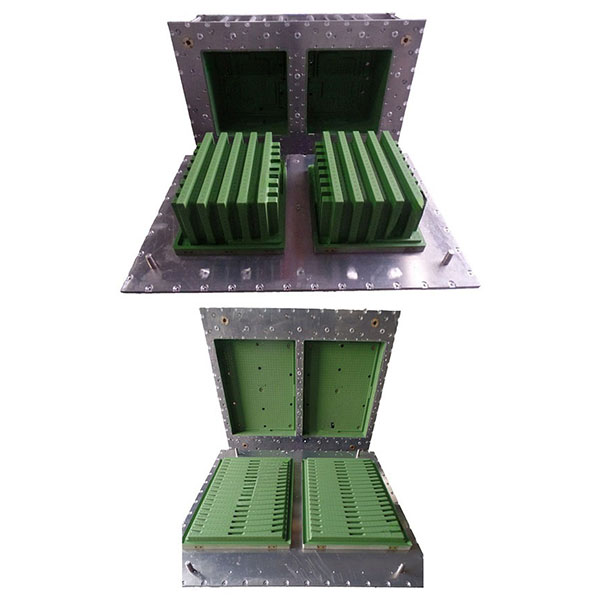
returnable container foam mold for tote insulation
Returnable container foam molds are used to form one‑piece or zoned foam liners and foam inserts inside returnable containers, tote boxes, or pallet boxes, providing cushioning, positioning, and protective functions for reusable packaging.
Returnable container foam molds support injection foaming, pour‑in foaming, or pour‑casting foaming processes to form uniform closed‑cell or semi‑closed‑cell foam structures within the cavity, improving part protection, loading stability, and container service life. They are suitable for scenarios such as electronic components, precision machinery, medical devices, fragile items, and supply‑chain transportation protection.
Key features of returnable container foam molds:
- Cushioning and protection: Through reasonable cavity zoning and material formulations, they provide point‑to‑point support and cushioning for products, reducing damage during transport and assembly.
- Positioning and alignment: Precise pockets and compartments can be designed into the foam liners to ensure accurate part positioning, facilitating picking and assembly.
- Foam uniformity: Precise cavity and runner design, properly arranged gates, and matched formulations ensure uniform foam density and closed‑cell ratio, providing consistent resilience and load‑bearing capacity.
- Durability and reusability: Wear‑ and compression‑resistant foam systems combined with reliable mold materials and heat‑treatment processes extend liner lifetime, making them suitable for frequent reuse.
- Lightweighting and energy savings: Material and structural optimization minimize weight while maintaining protective performance, reducing transport energy consumption and costs.
- Controllable surface and precision: Supports customization of surface texture, chamfers, and locating/guide features to improve mating accuracy and appearance consistency.
- Production efficiency: Supports multi‑cavity or combined‑mold designs and is compatible with automated loading/unloading and assembly lines, shortening cycle times, increasing output, and reducing per‑unit labor costs.
- Environmental performance and safety: Can be paired with low‑VOC, low‑odor, or non‑toxic foaming systems, and options such as flame‑retardant or anti‑static materials are available to meet specific industry requirements.
Applicable materials:
Compatible with a wide range of foam materials and composite systems, including polyurethane (PU) foams, polyethylene foams (EPE, PE), EVA, thermoplastic polyurethane (TPU), and other custom composite foam formulations. Material formulations can be adjusted according to impact resistance, resilience, wear resistance, flame‑retardant rating, and operating temperature range requirements.
Molding process description:
Supports injection foaming, pour‑in foaming, and pour‑casting foaming processes. Molds are configured with appropriate gates, venting channels, and temperature‑control systems to optimize foam expansion and cure profiles, reduce air pockets and sink marks, and ensure liner dimensional stability and surface quality.
Typical application scenarios:
Transportation and storage of electronic components, protection of precision mechanical parts, medical device handling, protection of optical components and gauges, logistics trays for automotive parts, circulation packaging and distribution of aircraft equipment and high‑value items, and other fields requiring high‑reliability protection and repeated reuse.