
 English
  Français
  Tiếng Việt
  Italiano
  Nederlands
  Türkçe
  Svenska
  Polski
  Română
  Latviešu
  한국어
한국어  Русский
  Español
  Deutsch
  Українська
  Português
  العربية
  Indonesian
  Čeština
  Suomi
Suomi  Eesti
Eesti  Български
  Dansk
Dansk  Lietuvių
  Bokmål
  Slovenčina
  Slovenščina
  Ελληνικά
  Magyar
  עברית
עברית 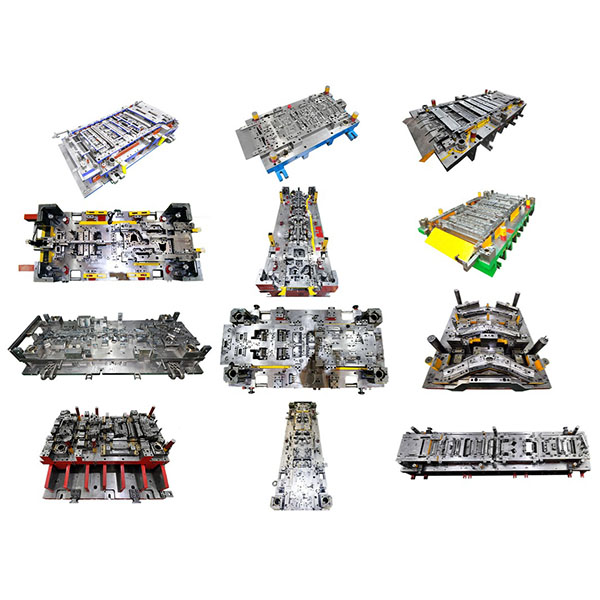
progressive stamping die for metal housings and clips
A progressive die is a die system that continuously feeds coil into the die and sequentially performs blanking, bending, forming, piercing and parting operations across multiple fixed stations.
Description
The progressive die process is suitable for high‑speed, continuous mass production and can efficiently produce complex, multi‑operation thin sheet parts on a single die set and a single feed line. Progressive dies are commonly used to manufacture small housings, contact parts, spring clips, electronic shield covers and other parts that require high takt rates and stable dimensions.
Main features of progressive dies:
- High speed and high capacity: Continuous coil feed and parallel station operation enable very short cycle times and stable output, suitable for medium to large volume production.
- High degree of process integration: Multiple operations are performed in sequence on the strip, reducing inter‑operation handling and manual intervention, improving yield and lowering labor costs.
- Good consistency and interchangeability: Precise die design and reliable locating ensure consistent part dimensions and geometry, facilitating subsequent assembly and interchangeability.
- Clear cost advantages: Low unit production cost and high material utilization; amortization over long die runs further reduces per‑unit manufacturing cost for mass production.
- Compact structure: Compared with transfer dies, progressive dies are generally more compact and occupy less floor space, suitable for high‑speed presses and automated production lines.
Applicable parts and application scenarios for progressive dies:
- Automotive parts: connectors, retainers, clips, electronic component shields, etc.
- Electronics and electrical appliances: battery contact strips, terminal connectors, sensor housings, small enclosures, etc.
- Home appliances and consumer products: decorative parts, fasteners, door hinge components, panel brackets, etc.
- Hardware and industrial parts: small flanges, gaskets, connection plates and other multi‑station formed thin sheet parts.
- Suitable scenarios: continuous production environments sensitive to cycle time, dimensional consistency and cost.
Materials and surface treatment recommendations:
- Common materials: cold‑rolled steel, stainless steel, copper and copper alloys, aluminum alloys and other cold‑formable sheet metals. Material grade and thickness must match die design, drawing ratios and stamping process.
- Surface treatments: Post‑processing such as electroplating, chemical plating, painting, e‑coating, and anodizing (for aluminum) can be applied; select treatment according to corrosion resistance, conductivity and appearance requirements.
- Design matching: Evaluate part formability and compatibility with downstream processes before selecting materials and surface treatments to avoid affecting stamping quality or assembly performance.
Key points in die design and manufacturing:
- Station layout and strip nesting: Arrange stations to optimize material utilization and operation sequence, control drawing ratios and strip geometry to reduce defects.
- Locating and guiding accuracy: Use precision guide posts, bushings and locating features to ensure synchronized positioning and machining accuracy across stations.
- Cutting edge and clearance design: Set appropriate blanking clearances and cutting edge radii based on material and thickness to extend tool life and improve blanking quality.
- Lubrication and scrap handling: Design effective lubrication schemes and scrap/ejection paths to prevent material sticking, scratching and jamming, ensuring continuous operation.
- Tryout and tuning: During die tryout, perform first‑part verification and cycle tuning; adjust station sequence, buffering and strip removal mechanisms as needed to stabilize output.
Process control and quality assurance:
- First article verification: After tryout, perform dimensional, appearance and functional inspection of first articles to confirm die and process parameters.
- Online monitoring: Apply stamping parameter monitoring, automatic counting and sampling inspection of critical dimensions to detect anomalies promptly and reduce defect rates.
- Maintenance: Regularly inspect cutting edge wear, guiding fits and lubrication status; replace consumables according to plan and log die usage life.
- Traceability: Establish batch and inspection records to facilitate problem tracing and continuous improvement.