
 English
  Français
  Tiếng Việt
  Italiano
  Nederlands
  Türkçe
  Svenska
  Polski
  Română
  Latviešu
  한국어
한국어  Русский
  Español
  Deutsch
  Українська
  Português
  العربية
  Indonesian
  Čeština
  Suomi
Suomi  Eesti
Eesti  Български
  Dansk
Dansk  Lietuvių
  Bokmål
  Slovenčina
  Slovenščina
  Ελληνικά
  Magyar
  עברית
עברית 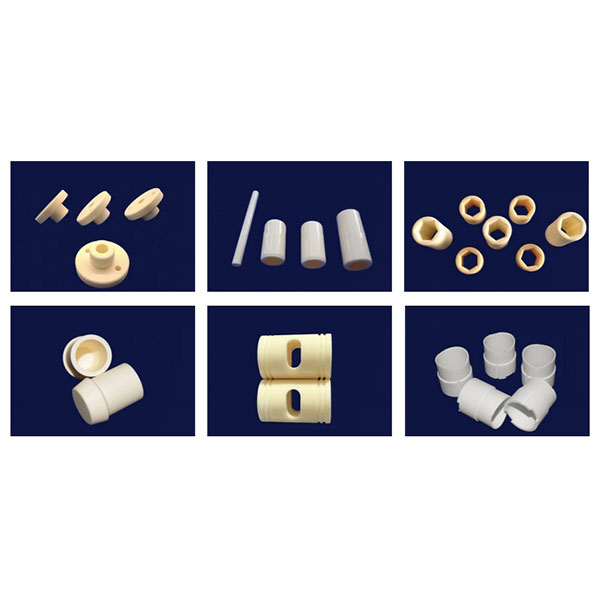
Precision CNC manufacturing services for ceramic bushings
We provide professional CNC machining services for ceramic bushings, focusing on reliable machining and quality control of ceramic materials (such as alumina, silicon nitride, silicon carbide, zirconia, etc.) under conditions of high hardness and brittleness.
Description
Through precision equipment, diamond tooling, and dedicated fixtures, we achieve high concentricity, precise fits, and excellent surface quality, meeting the requirements of high-temperature, vacuum, corrosive, and high‑wear applications.
Main advantages:
- Extremely high dimensional accuracy and concentricity, supporting micron‑level tolerance control.
- Excellent inner‑bore surface quality to reduce friction and wear, extending service life.
- Professional fixturing and temperature‑control solutions to reduce machining stress and deformation risk.
- Complete quality traceability system and functional testing to ensure batch consistency.
Equipment and tooling:
- Machines: High‑rigidity CNC lathes, three‑axis and five‑axis CNC machining centers, internal and external cylindrical grinders, turn‑grind compound machines, and ultra‑precision spindles, suitable for multi‑operation machining of outer diameters, inner bores and end faces.
- Tools and consumables: Diamond turning tools, diamond end mills, diamond grinding wheels, PCD and ultra‑hard coated tools, combined with ultra‑fine abrasives and polishing materials; tool geometry and cutting/grinding parameters are optimized for different ceramic materials.
- Auxiliary systems: Temperature‑controlled/thermostatic fixtures, vibration suppression, ultra‑high‑pressure cooling and particulate filtration, online measurement and automated loading/unloading to improve machining stability and consistency.
Main machining methods for CNC machining of ceramic bushings:
- Precision turning and boring: Establish outer diameter and inner bore datums, control concentricity and axial dimensions.
- Diamond grinding and honing: Through roughing, finishing and honing processes achieve strict inner‑bore tolerances and low surface roughness, suitable for mating surfaces and bearing contact faces.
- Ultrasonic vibration assisted machining (USM) and ultra‑fine grinding: Reduce cutting forces in brittle material processing, suppress crack propagation, and improve integrity of thin‑walled parts.
- EDM and micro‑machining trimming: Precisely finish complex internal cavities, blind holes, locating slots and similar features.
- Polishing and chemical mechanical polishing (CMP): Produce mirror finishes on sealing end faces and critical mating surfaces to further reduce friction and leakage risk.
Cooling, chip evacuation, and fixturing design:
- Cooling strategies: Use controlled cooling and highly filtered lubricants, and when necessary combine with coolant circulation and temperature‑controlled fixtures to avoid thermal deformation and dimensional drift.
- Chip evacuation and cleaning: Optimize toolpaths and chip channels, and apply ultrasonic and high‑pressure cleaning, vacuum chip removal and air blow‑off to prevent particles from affecting mating accuracy.
- Fixturing solutions: Custom mandrels, concentric supports, multi‑point supports and elastic locating designs to reduce clamping stress and ensure stability when machining thin‑walled parts.
Machinable materials and typical applications for CNC machining of ceramic bushings:
- Machinable materials: Alumina (Al2O3), silicon nitride (Si3N4), silicon carbide (SiC), zirconia (ZrO2) and various functional composite or coated ceramics.
- Typical applications: Ceramic bearing liners, vacuum equipment bushings, high‑temperature rotating components, wear‑ and corrosion‑resistant bushings, sensor and electrical insulation bushings, and sliding elements in precision transmissions.
Design recommendations and manufacturing notes:
- Wall thickness and geometry ratios: Avoid excessively thin walls or overly large length‑to‑diameter ratios. Add stiffening ribs or leave clamping areas when necessary to improve manufacturability.
- Fillets and chamfers: Provide appropriate chamfers at inner‑bore entries, end faces and assembly edges to reduce stress concentration and facilitate assembly.
- Machining allowance and fits: Specify machining allowances and fit tolerances on drawings; critical mating surfaces should reserve material for final grinding/polishing.