
 English
  Français
  Tiếng Việt
  Italiano
  Nederlands
  Türkçe
  Svenska
  Polski
  Română
  Latviešu
  한국어
한국어  Русский
  Español
  Deutsch
  Українська
  Português
  العربية
  Indonesian
  Čeština
  Suomi
Suomi  Eesti
Eesti  Български
  Dansk
Dansk  Lietuvių
  Bokmål
  Slovenčina
  Slovenščina
  Ελληνικά
  Magyar
  עברית
עברית 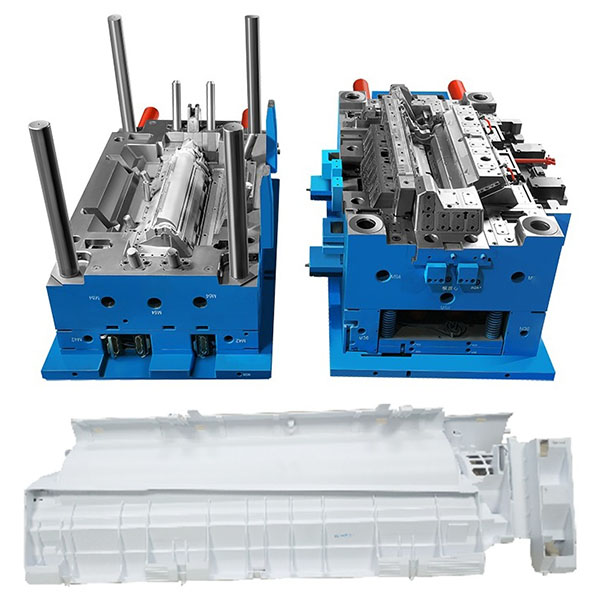
precision air conditioner base injection mold solutions
air conditioner base injection molds are used for mass production of air conditioner or outdoor unit bases, accommodating various plastic substrates and assembly requirements.
Description
air conditioner base injection molds emphasize dimensional stability, fit precision, and surface appearance consistency, support efficient injection molding production of complex structural parts, and are widely used in the supply chains of residential air conditioners, commercial air conditioners, and air conditioner accessories.
typical applications:
- residential and commercial outdoor unit bases and mounting brackets.
- indoor unit bases or internal support components.
- combined structural parts with inlet holes, snaps, and stud mounting positions.
- structural parts that require electrical or piping fixation and must withstand certain loads and vibrations.
mold structure and design considerations:
- cavity and matching schemes: a single mould with left-right symmetric arrangement or paired mould scheme can be adopted, choosing cavity count and layout according to production volume and part size.
- gating system: hot runner or cold runner schemes should be selected based on material and surface quality; valve-pin gates can be used in critical areas to improve surface quality and filling balance.
- cooling circuit design: to ensure consistent shrinkage and shorten cycle time, design equivalent cooling circuits and optimize flow rate distribution.
- cavity machining accuracy: focus on machining assembly datums and contact surfaces, and use mirror or fine machining where necessary.
- ejection and core-pulling mechanisms: for parts with internal cavities, complex snaps, or post-processing features, reasonably design ejector, side-pull, or slider mechanisms to ensure smooth demolding and protect delicate structures.
- deformation and stress control: reduce stress concentration and warp risk by ribs, thickness transition, and fillet treatment.
common materials and material selection recommendations:
- common engineering plastics: PP, ABS, PC, ABS, PA, PPO, TPE, etc.
- material selection considerations: mechanical strength, weather resistance, UV resistance, anti-aging, temperature resistance, and cost; for outdoor use or long-term exposure, prioritize weather-resistant and UV-resistant materials and validate additives.
injection molding process and production flow:
- trial moulding and parameter verification: perform initial trial moulding to verify filling, holding, mould temperature, and shrinkage, and adjust gate location and holding profile.
- process locking: establish injection speed, holding, cooling time, and mould temperature control strategy, and create qualified process documentation.
- mass production and monitoring: ensure batch consistency through SPC, online dimensional inspection, and appearance monitoring; when key parameters deviate, trigger alarms and stop the line for inspection.
- post-processing and pre-assembly inspection: deburring and insert or fastener assembly followed by functional and assembly inspection; perform surface treatment or painting if necessary.