
 English
  Français
  Tiếng Việt
  Italiano
  Nederlands
  Türkçe
  Svenska
  Polski
  Română
  Latviešu
  한국어
한국어  Русский
  Español
  Deutsch
  Українська
  Português
  العربية
  Indonesian
  Čeština
  Suomi
Suomi  Eesti
Eesti  Български
  Dansk
Dansk  Lietuvių
  Bokmål
  Slovenčina
  Slovenščina
  Ελληνικά
  Magyar
  עברית
עברית 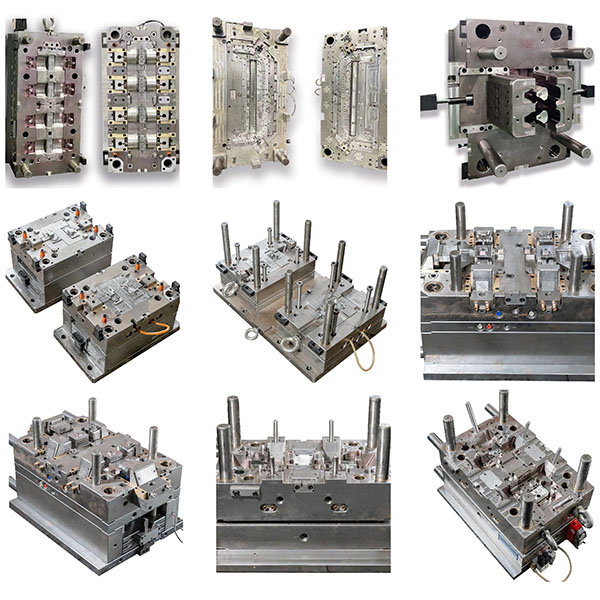
plastic injection mold for durable parts in high volume
Plastic injection molds are precision tools used for mass production of plastic parts. By injecting molten plastic into mold cavities and cooling to form parts, they provide a manufacturing method that achieves high efficiency, low per-piece cost, and stable dimensions.
Description
Plastic injection molds are suitable for a wide range of industries including consumer goods, automotive parts, electronic housings, medical devices, home appliances, and industrial components.
Mold types:
- Single-cavity and multi-cavity molds: choose single- or multi-part molding per cycle based on production volume.
- Hot runner and cold runner molds: hot runner molds help reduce material waste and improve efficiency; cold runner molds are used when cost sensitivity or specific material requirements apply.
- Vertical and horizontal molds: selected according to the injection molding machine configuration and part takeout method.
- Pin-insert molds, slide molds, and side core pull molds: used to form parts with complex side holes, internal threads, or multiple parting lines.
- Insert molds: support integral molding with metal or other material inserts.
Design and manufacturing processes of plastic injection molds:
- Structural design: includes the gating system, venting design, cooling circuits, ejection mechanism, guide pillars and bushes, and positioning systems to ensure stable molding and reliable demolding.
- Gating system optimization: optimize gate locations, runner cross-sections, and hot runner layouts based on flow analysis (CAE) to reduce warpage and sink marks.
- Cooling system design: uniform cooling improves dimensional stability and shortens cycle time; supports conformal cooling designs.
- Venting and demolding: properly set vents to prevent burn marks and gas porosity; the ejection system ensures parts are removed smoothly without deformation.
- Machining processes: CNC precision machining, EDM, wire cutting, grinding, assembly, and trial adjustment.
Precision and performance:
- Dimensional stability: ensure long-term production dimension stability through mold pre-stress design, temperature control, and selection of mold materials.
- Surface quality: polishing and texture treatments can achieve mirror finish, matte finish, or custom textures.
- Capacity and lifespan: standard mold life can reach hundreds of thousands to millions of injection cycles; wear-resistant materials and regular maintenance can extend service life.
Surface treatments and post processes:
- Mold cavity surfaces can be engraved with various textures or brand logos; molded parts can subsequently undergo painting, electroplating, silk-screening, heat transfer printing, and other surface treatments.
- For parts requiring secondary processing, molds can be designed to facilitate later assembly or insert installation.
Application fields:
Automotive parts, electronic and electrical housings, home appliances, medical devices, consumer electronics, packaging, toys, industrial components, and almost any industry that requires mass production of plastic parts.