
 English
  Français
  Tiếng Việt
  Italiano
  Nederlands
  Türkçe
  Svenska
  Polski
  Română
  Latviešu
  한국어
한국어  Русский
  Español
  Deutsch
  Українська
  Português
  العربية
  Indonesian
  Čeština
  Suomi
Suomi  Eesti
Eesti  Български
  Dansk
Dansk  Lietuvių
  Bokmål
  Slovenčina
  Slovenščina
  Ελληνικά
  Magyar
  עברית
עברית 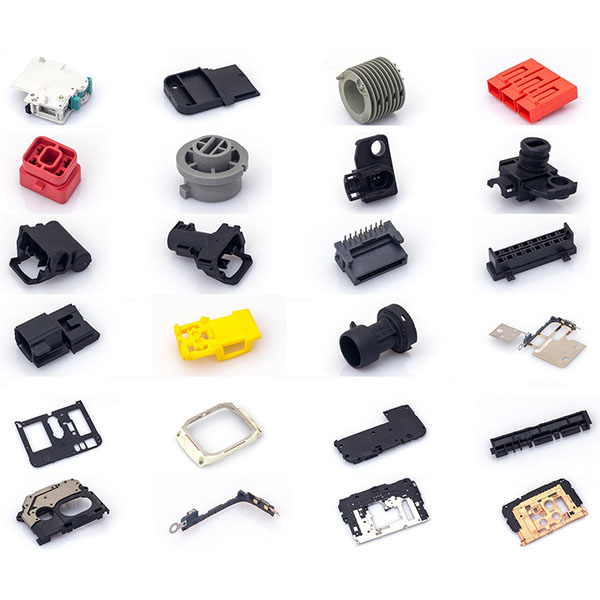
other injection-molded parts manufacturing and assembly
Other injection-molded parts manufacturing provides integrated services from product review, mold design, and injection molding to post-processing and assembly, suitable for electronics, electrical appliances, industrial equipment, automotive parts, consumer products, and various customized plastic parts.
Description
We focus on efficient mass production, part consistency, and cost optimization, while also supporting quick small-batch prototyping and seamless switching to mass production.
Applicable part types:
- Structural parts: brackets, connectors, fasteners, gears, and other load-bearing or locating components.
- Appearance parts: panels, housings, decorative components, and brand identification pieces.
- Functional parts: gears, sliders, valve bodies, flow-guiding components, and seals.
- Precision small parts: snap-fits, bushings, pin carriers, and guide posts.
- Composite parts: hard-soft combinations (TPE/TPR overmolding), insert molding, and assembly components.
Mold and design key points:
- Cavity design: Select single-cavity or multi-cavity molds according to output, and optimize cavity layout to improve capacity and flow balance.
- Cooling and injection balance: Balanced cooling circuits and reasonable gate layout can shorten cycle times and reduce warpage and stress concentration.
- Gates and hot-runner systems: Choose appropriate gate types based on part geometry and production volume; use hot-runner systems when necessary to reduce scrap and shorten cycles.
- Venting and shrinkage compensation: Properly set vents and packing/holding strategies to prevent burn marks, porosity, and sink marks.
- Inserts and allowances for secondary operations: Consider insert positions, screw bosses, and assembly tolerances during the design stage.
- Surface-finishing preparation: Reserve appropriate machining and polishing operations in the mold for painting, electroplating, heat transfer, or textured surfaces.
Injection molding process and production flow:
- Prototypes and mold trials: Produce prototypes and perform mold flow analysis (Moldflow) for validation, then adjust gating and cooling schemes before mold trial optimization.
- Process parameter control: Precisely control melt temperature, injection speed, packing/holding, and cooling time, and record SPC data to ensure stability.
- Automation and assembly lines: Support integrated production with robotic part removal, visual inspection, ultrasonic welding, hot riveting, or mechanical assembly lines.
- Rapid small-batch changeover: Establish flexible production scheduling and mold-change procedures to shorten lead times for small-batch and multi-SKU deliveries.
Surface treatments and subsequent processes:
- Surface treatments: Spray painting, baked coatings, electroplating, silkscreen printing, heat transfer printing, and laser marking to meet various appearance requirements.
- Secondary assembly: Riveting, screw assembly, ultrasonic welding, hot-plate welding, or adhesive bonding can be integrated into the production line.
- Packaging and labeling: Provide single-piece protection, boxed separators, or pallet packing based on product characteristics, and support barcode/batch labeling.