
 English
  Français
  Tiếng Việt
  Italiano
  Nederlands
  Türkçe
  Svenska
  Polski
  Română
  Latviešu
  한국어
한국어  Русский
  Español
  Deutsch
  Українська
  Português
  العربية
  Indonesian
  Čeština
  Suomi
Suomi  Eesti
Eesti  Български
  Dansk
Dansk  Lietuvių
  Bokmål
  Slovenčina
  Slovenščina
  Ελληνικά
  Magyar
  עברית
עברית 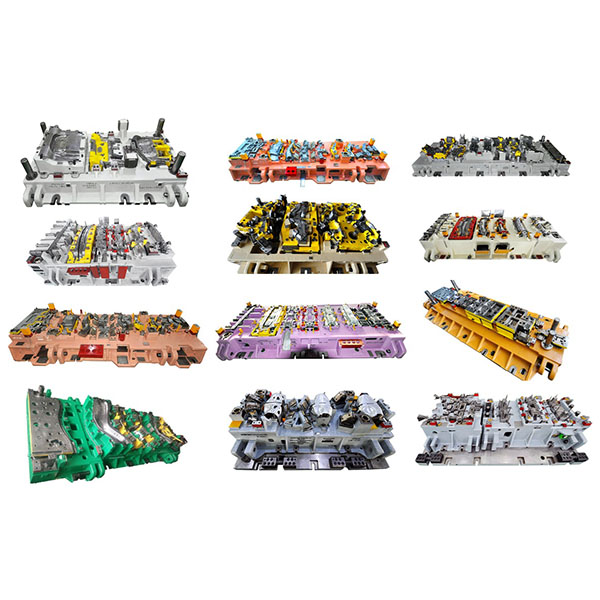
multi-station transfer stamping die for high-volume output
A multi-station transfer stamping die is a die system in which multiple independent processing stations are set up within the same die frame, and parts are transferred from one station to the next between strokes by transfer mechanisms to be progressively formed.
Description
Multi-station transfer stamping die combines the process flexibility of transfer forming with the capability of parallel processing across multiple stations, making it suitable for producing large-size or medium-thickness metal parts that require multiple complex forming steps, flipping/rotation, or multi-sided processing.
Key features and advantages of multi-station transfer stamping die:
- Process flexibility: Each station can be independently configured for forming, piercing, bending, flipping/rotation, or assembly operations, facilitating complex geometries and multi-sided processing.
- Improved yield: Independent stations allow optimization of forming conditions, reducing concentrated deformation stresses and increasing finished-part pass rates.
- Scalable capacity: Parallel cavity designs or parallel station layouts can be adopted at each station to balance production capacity and process requirements.
- Automatable: In combination with robots or transfer mechanisms, automatic feeding, indexing/transfer, ejection, and stacking can be achieved, reducing labor costs.
- Suited for large parts and deep drawing: Compared to progressive dies, transfer dies are better suited for stable processing of deep-drawn, large-size, or multi-directionally formed parts.
Applicable scenarios for multi-station transfer stamping die:
- Automotive structural parts, lighting housings, chassis parts, and heat shields that require multiple complex forming steps or deep drawing.
- Parts requiring intermediate flipping/rotation, localized clamping, or in-die assembly/welding.
- Workpieces with large single-part dimensions or parts for which strip feeding in a progressive die is impractical.
Design highlights and process considerations:
- Transfer and positioning: Transfer mechanisms (grippers, push rods, robots, or rotary tables) must ensure high positioning accuracy to avoid cumulative errors. Locating pins and clamping systems must guarantee repeatable positioning across stations.
- Force balance: The die structure must ensure rigidity, reasonably distribute forces across stations, and incorporate a uniform ejection system to prevent deformation or part jamming.
- Station layout: Arrange stations according to process difficulty and space requirements; use modular or replaceable cavity plates when necessary for easier maintenance and reconfiguration.
- Cutting edges and clearance control: Consistency of cutting edges across stations directly affects dimensional stability and edge quality; strict control of manufacturing and assembly tolerances is required.
- Chip removal and lubrication: For large die bodies, design effective chip removal channels and lubrication supply to extend cutting-edge life and ensure production stability.