
 English
  Français
  Tiếng Việt
  Italiano
  Nederlands
  Türkçe
  Svenska
  Polski
  Română
  Latviešu
  한국어
한국어  Русский
  Español
  Deutsch
  Українська
  Português
  العربية
  Indonesian
  Čeština
  Suomi
Suomi  Eesti
Eesti  Български
  Dansk
Dansk  Lietuvių
  Bokmål
  Slovenčina
  Slovenščina
  Ελληνικά
  Magyar
  עברית
עברית 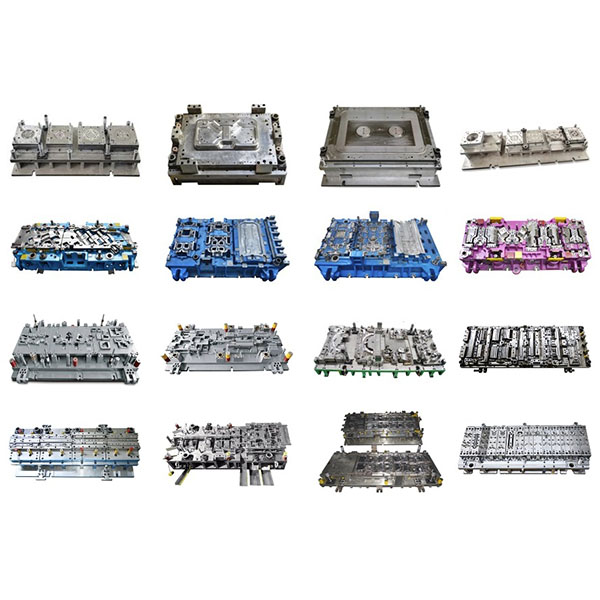
metal stamping die design testing and maintenance support
A stamping die refers to a dedicated die used for metal stamping processes; in cooperation with a press, it realizes blanking, forming, bending, deep drawing, and subsequent trimming operations on metal sheets.
Description
Stamping dies are suitable for mass production of metal parts and widely serve industries such as automotive, home appliances, electronics, hardware, construction, and industrial equipment. They enable highly efficient production while ensuring dimensional consistency and surface quality.
Main features of stamping dies:
- High efficiency and high capacity: Employ rational strip layout and multi-station linked structures (such as progressive dies and transfer dies) to significantly increase processing rhythm, making them well suited for mass production.
- Precision and repeatability: Through precision cavities and reliable locating and feeding systems, ensure key dimensional tolerances and part interchangeability, reducing assembly adjustment costs.
- Process versatility: Support a variety of operations including blanking, deep drawing, flanging, bending, forming, trimming, and punching, and can integrate secondary operations (spot welding, riveting, etc.).
- Easy maintenance and long service life: Use wear‑resistant alloy steels, advanced heat treatments, and surface strengthening processes to improve wear and anti‑adhesion performance, extend die life, and reduce downtime.
- Customization capability: Provide tailored die solutions and process validation based on part geometry, material, and production requirements.
Design and manufacturing key points for stamping dies:
- Strip layout and process planning: Design strip layout, takt time, and station allocation based on part geometry and material characteristics to minimize material waste and optimize process flow.
- Cavity precision and manufacturing datum: Design locating datums and die clearances appropriately, taking into account elastic springback, sheared‑edge burrs, and assembly allowances to ensure first‑part conformance and stable mass production.
- Guiding and locating systems: Use precise guide pillars, bushings, and locating pins to ensure stable alignment during high‑speed operation, reducing abnormal wear and scrap rates.
- Cooling and lubrication schemes: Provide effective cooling and lubrication designs for necessary die areas to reduce friction and thermal accumulation, improving forming quality and die life.
- Surface and heat treatments: Select appropriate die steels and apply quenching, tempering, nitriding, or coating treatments (such as nitriding, PVD, etc.) to enhance wear resistance and anti‑adhesion properties.
Materials and applicable part types:
- Applicable materials: Cold‑rolled steel, hot‑rolled steel, stainless steel, galvanized sheet, aluminum alloys, copper and copper alloys, etc.; specific material grades and thicknesses should be chosen based on formability assessments and post‑processing requirements.
- Thickness range: Typical processing thicknesses generally range from 0.3 mm to 6.0 mm; special thick or ultra‑thin parts require feasibility confirmation and die scheme review during engineering evaluation.
- Typical parts: Body structural parts, brackets, panels, fasteners, springs, hardware accessories, and inner, outer housings for home appliances, etc.