
 English
  Français
  Tiếng Việt
  Italiano
  Nederlands
  Türkçe
  Svenska
  Polski
  Română
  Latviešu
  한국어
한국어  Русский
  Español
  Deutsch
  Українська
  Português
  العربية
  Indonesian
  Čeština
  Suomi
Suomi  Eesti
Eesti  Български
  Dansk
Dansk  Lietuvių
  Bokmål
  Slovenčina
  Slovenščina
  Ελληνικά
  Magyar
  עברית
עברית 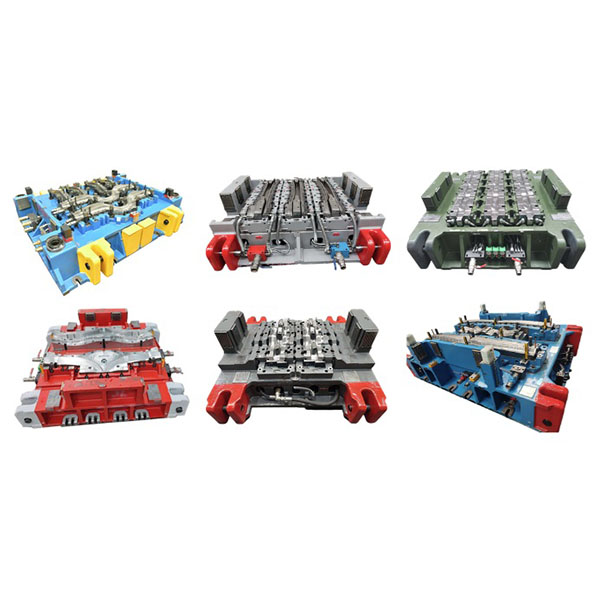
hot stamping die engineering and custom tooling services
A hot stamping die is a dedicated die used for the hot stamping (integrated hot forming and quenching) process. It is suitable for rapidly forming and quenching preheated or in‑die heated high‑strength steels or other alloy sheets to achieve the required mechanical properties and precise dimensions.
Description
Hot stamping dies are widely used in the production of automotive structural components, safety parts, and other components that require both high strength and lightweight properties.
Main features of hot stamping dies:
- Integrated high-temperature forming and quenching: The die and process achieve close integration of heating, forming, and quenching to ensure the part’s strength and plasticity requirements.
- Precise dimensions and consistency: Through precision cavities and proper thermal management design, finished parts achieve stable geometry, tight form-and-position tolerances, and good interchangeability.
- High-temperature and wear‑resistant design: Select heat‑resistant and wear‑resistant die materials and apply suitable heat treatment and surface treatment processes to improve die life.
- Process traceability and stability: Support recording of process parameters and online monitoring for mass production, facilitating quality traceability and anomaly analysis.
Applicable materials and part types for hot stamping dies:
- Common materials: Hot‑forming steels (such as martensitic carbon steels), some high‑alloy steels, and aluminum alloys adapted for the process; specific materials should be selected based on forming‑and‑quenching performance evaluations.
- Typical parts: Load‑bearing and crash components (B‑pillars, side sills, crossmembers, etc.), high‑strength structural parts, and safety components that require high strength and high stiffness.
Design and manufacturing key points:
- Thermal management and temperature control: Dies should be equipped with efficient cooling and heating channel designs to ensure a uniform temperature field during forming and enable rapid quenching.
- Cavity precision and compensation design: Consider material thermal expansion and quench shrinkage; design appropriate cavity compensation and dimensional prediction models.
- Locating and clamping mechanisms: Reliable locating and clamping prevent sheet sliding, warping, or wrinkling when heated, ensuring forming quality.
- Surface and material treatments: Die surfaces should employ nitriding, coatings, or other wear‑ and anti‑adhesion measures to reduce material sticking and wear, while facilitating cleaning and maintenance.
Quality control and tryout verification:
- Tryout testing: During tryout, the first article should be tested for dimensions, microstructure, hardness, appearance, and functionality to validate the process route and die design.
- Online monitoring: It is recommended to monitor heating temperature, forming speed, in‑die temperature, and cooling parameters, and to record key data for traceability.
- Process optimization: Based on tryout results, adjust heating strategies, clamping sequences, and cooling channel parameters to improve yield and extend die life.