
 English
  Français
  Tiếng Việt
  Italiano
  Nederlands
  Türkçe
  Svenska
  Polski
  Română
  Latviešu
  한국어
한국어  Русский
  Español
  Deutsch
  Українська
  Português
  العربية
  Indonesian
  Čeština
  Suomi
Suomi  Eesti
Eesti  Български
  Dansk
Dansk  Lietuvių
  Bokmål
  Slovenčina
  Slovenščina
  Ελληνικά
  Magyar
  עברית
עברית 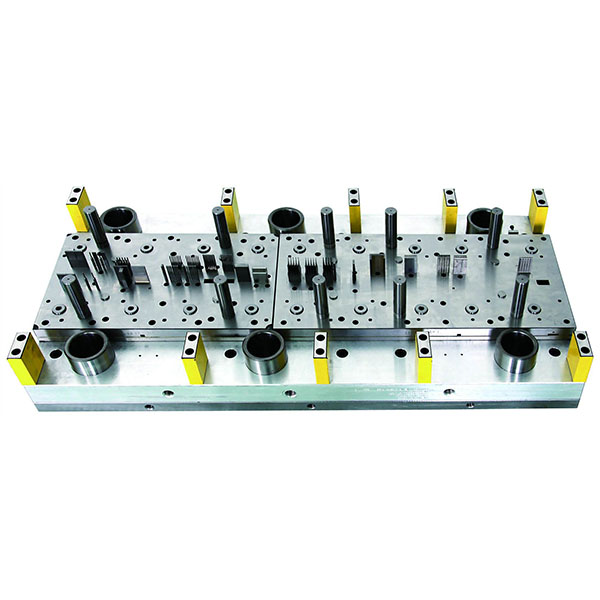
high-speed press die for precise large-volume production
high-speed press dies are specifically designed for high-speed, high-volume production and are suitable for forming thin-sheet parts that require high cycle rates, high precision and long-term stability.
Description
high-speed press dies are optimized in structural rigidity, wear resistance, lubrication and chip evacuation design to ensure dimensional accuracy, surface quality and long service life under high-speed stamping conditions, and are commonly used for production of electronic enclosures, appliance panels, small automotive parts and other high-volume components.
main features of high-speed press dies:
- high-speed production: the die is co-designed with feeding systems and presses to match high-speed press cycles, delivering high output per unit time and suiting automated production lines.
- high precision and stability: precise guidance, fits and springback compensation ensure repeatability of critical dimensions such as blanking, piercing and bending.
- wear resistance and durability: key components use high-wear-resistant die steels with heat treatment and surface treatments (such as nitriding or pvd coatings) to reduce wear and sticking, improving die life.
- optimized lubrication and chip evacuation: lubrication methods and channels are optimized for high-speed conditions; die structures also facilitate chip removal and ejection to reduce jamming and unexpected stoppages.
- automation compatibility: compatible with continuous/progressive dies, transfer dies, or integration with automated feeding and handling systems to minimize manual intervention.
applicable die types for high-speed press dies:
- progressive/multi-station die: suitable for extremely high output and cycle rate requirements, allowing the strip to be formed sequentially across multiple stations.
- transfer die: suitable for complex forming or multi-axis operations and can be paired with specialized feeding equipment.
- compound die: performs multiple operations in a single stroke, suitable for simpler part structures that require high efficiency.
- deep-draw die: used on high-speed production lines that require fast and stable deep-drawing operations, often combined with dedicated hydraulic or servo control processes.
material and heat treatment recommendations:
- common die steels: skd11, h13, s45c, etc., with material selection and heat treatment according to part function.
- surface reinforcement: nitriding, carbo-nitriding or pvd coatings are recommended for critical punches, cavities and guide components to improve anti-sticking and wear resistance.
- consider lubrication compatibility: surface treatments should be compatible with lubricants used in production to avoid coating delamination or lubricant failure.
design and process control key points:
- clearance and edge treatment: under high-speed conditions, precisely control blanking clearance and edge chamfers to ensure section quality and reduce blanking force fluctuation.
- springback compensation and rigidity: design springback compensation based on material properties and bend radius to improve angle and fit accuracy; ensure sufficient rigidity of die blocks and guides to reduce vibration.
- blankholder force and vibration control: reasonably design blankholder force and buffering devices to avoid ripples, wrinkling or local cracking at high speed; use vibration damping or stabilizing devices if necessary.
- chip removal, ejection and cooling: efficient chip removal and ejection are critical at high cycle rates, and temperature rise control measures are needed to maintain dimensional stability.
- safety and monitoring: it is recommended to integrate die force monitoring, online inspection or strip-break detection to ensure equipment and process stability.