
 English
  Français
  Tiếng Việt
  Italiano
  Nederlands
  Türkçe
  Svenska
  Polski
  Română
  Latviešu
  한국어
한국어  Русский
  Español
  Deutsch
  Українська
  Português
  العربية
  Indonesian
  Čeština
  Suomi
Suomi  Eesti
Eesti  Български
  Dansk
Dansk  Lietuvių
  Bokmål
  Slovenčina
  Slovenščina
  Ελληνικά
  Magyar
  עברית
עברית 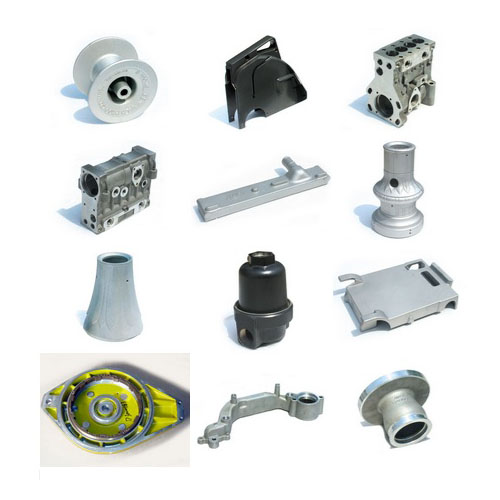
gravity die castings for durable precision metal parts
The gravity die casting process focuses on pouring molten metal by gravity into reusable metal molds (permanent molds) to produce metal components with excellent dimensional stability, surface quality and balanced mechanical properties.
The gravity die casting process combines the flexibility of sand casting with the surface finish and dimensional advantages of pressure die casting, making it suitable for medium-to-small batch and mass production scenarios that require higher geometric accuracy, good surface smoothness and reliable structural performance.
Main features of gravity die casting:
- Good dimensional accuracy and surface quality: Formed in metal molds with uniform cooling, producing smooth surfaces that reduce secondary machining.
- Superior mechanical properties: Faster heat transfer and moderate solidification rates in metal molds yield castings with higher density and better microstructure than conventional sand castings.
- Balance of cost and efficiency: Durable molds and decreasing unit cost with volume make the process suitable for medium-to-large production runs; cavity changes are flexible and mold lead times are shorter than for complex high-pressure die-casting molds.
- Controllable tolerance range: Mold design and process parameter control enable tight dimensional tolerances, facilitating downstream machining and assembly requirements.
- Wide material adaptability: Supports aluminum alloys, copper alloys, magnesium alloys, zinc alloys and some low-alloy steels to meet various mechanical and corrosion-resistance needs.
Materials and process highlights:
- Common materials: Aluminum alloys (commonly used for structural parts and housings), copper alloys (for wear-resistant or conductive components), zinc alloys (for small, complex-shaped parts), and magnesium alloys (for lightweight components).
- Molds and pouring: Steel or cast-iron permanent molds are used and filled by gravity pouring; mold surfaces can be treated with wear-resistant or insulating coatings to extend life and stabilize solidification.
- Cooling and solidification control: Mold cooling design, gate and riser layout, and core venting are used to control solidification direction and reduce shrinkage cavities, sinks and inclusion defects.
- Subsequent heat treatment: Depending on material and performance requirements, annealing, solution treatment, aging and other heat treatments are provided to optimize mechanical properties.
Typical application areas:
Gravity die castings are widely used for automotive and motorcycle components, pump and valve bodies, transmission and support structural parts, instrument housings, LED lighting heat sinks, architectural hardware and fasteners, non-critical aerospace structures, and various medium-to-large structural parts of machinery where dimensional accuracy and mechanical performance are both required.