
 English
  Français
  Tiếng Việt
  Italiano
  Nederlands
  Türkçe
  Svenska
  Polski
  Română
  Latviešu
  한국어
한국어  Русский
  Español
  Deutsch
  Українська
  Português
  العربية
  Indonesian
  Čeština
  Suomi
Suomi  Eesti
Eesti  Български
  Dansk
Dansk  Lietuvių
  Bokmål
  Slovenčina
  Slovenščina
  Ελληνικά
  Magyar
  עברית
עברית 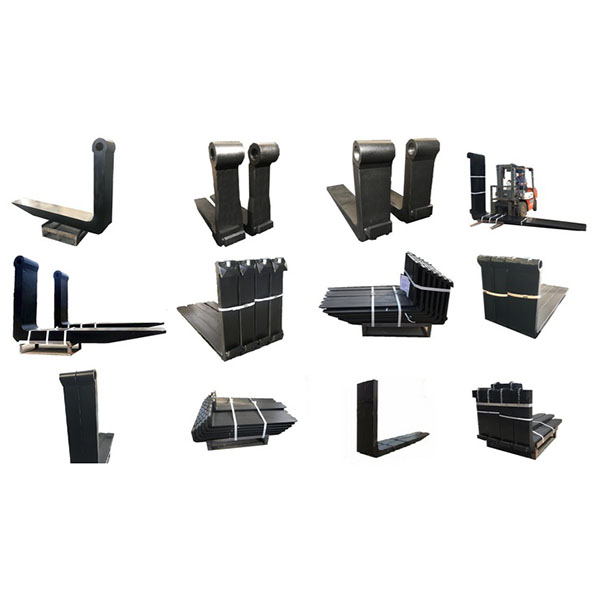
forged forklift fork for heavy duty material handling
The forged forklift fork is a key load-bearing component for forklifts, stackers and other handling equipment. It is produced by forging processes and features a dense metallographic structure and excellent mechanical properties.
Compared with welded or cast forks, forged forklift forks offer significant advantages in strength, toughness, fatigue resistance, and impact resistance, enabling them to withstand heavy loads, impacts, and complex working conditions for extended periods and ensuring safe and reliable material handling operations.
Materials and specifications:
- Common materials: carbon and alloy steels (e.g., 45#, 20MnCr5, 42CrMo, 35CrMo, etc.). Depending on operating conditions, carburizing steels or quenched-and-tempered steels can be selected to improve surface wear resistance and core toughness; stainless steel is available for corrosion resistance or special environments.
- Dimensions and load ratings: length, width, thickness and load capacity can be customized according to customer model or drawings (load ratings can be specified per ISO/EN/ANSI standards or customer requirements).
- Surfaces and interfaces: pin holes, mounting slots, side plates and reinforcements can be machined per requirements; technical specifications for surface hardness, flatness and geometric tolerances can be provided.
- Certification support: material test certificates (MTC), chemical composition and mechanical property reports can be provided; third‑party inspection and certification are supported.
Manufacturing process of forged forklift fork:
- Forging: blanks are formed by open-die or closed-die forging to optimize metal fiber flow, ensuring dense microstructure and uniform mechanical properties.
- Heat treatment: normalizing, quenching and tempering, carburizing or quenching-and-tempering are performed according to material and service conditions to achieve the required surface hardness and core toughness.
- Machining: CNC machining, milling, drilling, sawing and grinding are used to finish critical mating surfaces and interface locations, ensuring assembly fit and accuracy.
- Surface strengthening: optional treatments include carburizing + quenching, nitriding, induction hardening, shot peening or chrome plating to improve wear resistance and fatigue life.
- Surface protection: sandblasting, phosphating, painting or thermal spray coatings are available for different corrosive environments.
Performance characteristics:
- High strength and high toughness: forging structure and appropriate heat treatment provide excellent load-bearing capacity and impact resistance.
- Fatigue and wear resistance: surface strengthening processes and material selection significantly extend service life and maintenance intervals.
- Dimensional stability and good interchangeability: precision machining ensures easy assembly and replacement, facilitating maintenance.
- Strong customization capability: cross-section, reinforcement structure and heat treatment schemes can be customized according to load, operating frequency and conditions to optimize weight and strength.
Applications:
Forged forklift forks are suitable for various warehousing and logistics equipment, manufacturing plants, ports and terminals, distribution centers and other heavy-duty handling scenarios. They are widely used as fork components for internal combustion or electric forklifts, stackers and multifunctional handling vehicles.