
 English
  Français
  Tiếng Việt
  Italiano
  Nederlands
  Türkçe
  Svenska
  Polski
  Română
  Latviešu
  한국어
한국어  Русский
  Español
  Deutsch
  Українська
  Português
  العربية
  Indonesian
  Čeština
  Suomi
Suomi  Eesti
Eesti  Български
  Dansk
Dansk  Lietuvių
  Bokmål
  Slovenčina
  Slovenščina
  Ελληνικά
  Magyar
  עברית
עברית 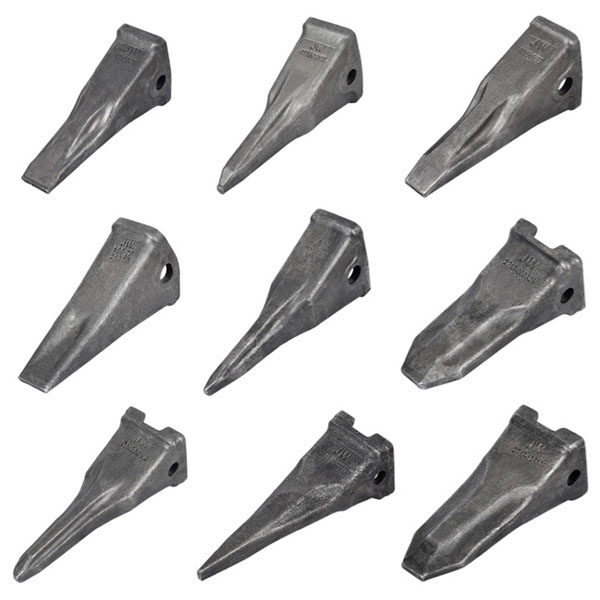
forged excavator bucket teeth for harsh ground conditions
forged excavator bucket teeth are manufactured from high-strength alloy steel through forging and heat treatment processes, and are the critical wear parts in the tooth-and-adapter system that bear impact and abrasion.
Description
through reasonable material formulations, precise forging forming, and strict heat treatment and surface treatments, the tooth body is ensured to have excellent wear resistance, impact resistance, and service life, thereby improving excavation efficiency and reducing maintenance and replacement costs.
materials and specifications:
- common materials: high-manganese steel, alloy tool steels, low-alloy wear-resistant steels and quenched-and-tempered steels subjected to special heat treatment, etc., can be selected according to working conditions or customized per customer requirements.
- models and dimensions: support standard bucket tooth specifications compatible with major brands and models (customizable according to drawings or samples), and can provide different lengths, widths, interface types—pin-lock, bolt-on, quick-change, etc.—and weight options.
- tolerances and inspection: provide strict dimensional tolerance control and factory inspection reports to ensure interchangeability with bucket adapters and sleeves and to facilitate easy installation.
manufacturing process:
- forging forming: closed-die forging or open-die forging processes are used to optimize metal flow lines, refine the microstructure and reduce inherent defects, improving impact and fatigue resistance.
- heat treatment processes: according to material and usage requirements, perform quenching, tempering, surface hardening or localized induction hardening to achieve a matched structure of high hardness at the tooth tip and toughness at the tooth root.
- finishing and profiling: key mating surfaces, locating holes and mounting slots are machined by turning, milling or grinding to ensure assembly fit and installation positioning accuracy.
- surface treatments: optional carburizing, nitriding, thermal spraying or ceramic/metal coatings can be applied to further enhance wear resistance and corrosion resistance.
performance characteristics:
- high wear resistance: material selection combined with surface hardening and other treatments significantly improve the wear life of the tooth tip and contact surfaces.
- strong impact resistance: forged microstructure and proper heat treatment make the tooth body less likely to crack or fracture under impact loads.
- good toughness and fatigue performance: the tooth root area retains sufficient toughness to withstand repeated loads and fatigue failure.
- precise interchangeability: machining and inspection ensure dimensional interchangeability with original or universal adapters, facilitating rapid on-site replacement.
- multi-condition adaptation: material selection and heat treatment schemes can be optimized for different ground conditions such as gravel, clay, rock or stone fragments.
applications and working conditions:
- forged excavator bucket teeth are widely used on excavators, loaders, digging attachments and loading equipment for earthworks, mining, construction, roadworks, quarrying and other heavy digging scenarios.
- forged excavator bucket teeth are suitable for high-wear, high-impact environments or operations that require frequent tooth replacement.