
 English
  Français
  Tiếng Việt
  Italiano
  Nederlands
  Türkçe
  Svenska
  Polski
  Română
  Latviešu
  한국어
한국어  Русский
  Español
  Deutsch
  Українська
  Português
  العربية
  Indonesian
  Čeština
  Suomi
Suomi  Eesti
Eesti  Български
  Dansk
Dansk  Lietuvių
  Bokmål
  Slovenčina
  Slovenščina
  Ελληνικά
  Magyar
  עברית
עברית 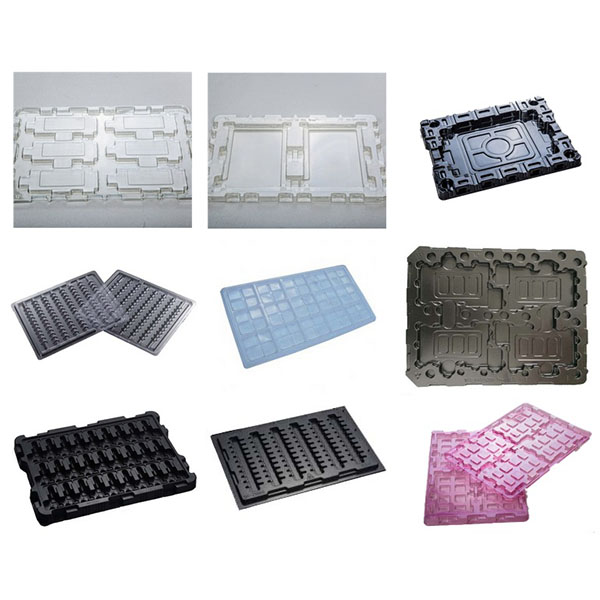
ESD-safe vacuum-formed tray for electronic packaging
ESD-safe vacuum-formed trays are used to provide protection and positioning for electronic components, semiconductors, precision modules, and other electrostatically sensitive products.
Description
By applying antistatic formulations or composite antistatic layers to thin thermoplastic sheets and combining this with vacuum forming processes, ESD-safe vacuum-formed trays with good static-dissipative properties, precise locating features, and cushioning structures can be rapidly manufactured, suitable for packaging, storage, transportation, and production line organization.
Applicable materials:
- Common base materials: thermoplastic sheets such as PET, PS, HIPS, ABS, PVC, PP, etc., treated for antistatic performance or compounded with antistatic additives.
- Functional composite sheets: multilayer sheets with surface-applied or co-extruded antistatic layers, or integrated conductive/static-dissipative composite materials to meet different surface resistance and dissipation requirements.
- Material specifications: materials can be selected to meet different volume resistance/surface resistance levels per customer requirements (for example, compliant with ESD S20.20 guidelines or customer-specified standards).
Advantages and features:
- Effective ESD protection: surfaces provide good dissipative properties to reduce the risk of electrostatic discharge (ESD) damage to sensitive components.
- Precise positioning and protection: recesses and support structures can be customized to product contours to ensure stability and cushioning during transport and assembly.
- Cost and lead-time advantages: compared with injection molding, vacuum-formed trays require lower mold investment and offer shorter sample and small-to-medium batch lead times, making them suitable for iterations and short-to-medium production runs.
- Integration of labeling and traceability: supports screen printing or inkjet coding for batch management and automated identification.
- Recyclable and eco-friendly options: recyclable materials and take-back/recycling schemes can be adopted to support green packaging strategies.
Typical application scenarios for ESD-safe vacuum-formed trays:
- Electronic component packaging and handling: trays and separators for sensitive components like ICs, modules, sensors, connectors, etc.
- Production-line stations and assembly fixtures: antistatic trays used for parts transfer, picking, and feeding on production lines.
- Storage and transport protection: antistatic transport liners used with outer cartons to provide comprehensive protection for precision parts.
- Electronic product display and testing trays: antistatic trays used for testing, aging, or display applications.