
 English
  Français
  Tiếng Việt
  Italiano
  Nederlands
  Türkçe
  Svenska
  Polski
  Română
  Latviešu
  한국어
한국어  Русский
  Español
  Deutsch
  Українська
  Português
  العربية
  Indonesian
  Čeština
  Suomi
Suomi  Eesti
Eesti  Български
  Dansk
Dansk  Lietuvių
  Bokmål
  Slovenčina
  Slovenščina
  Ελληνικά
  Magyar
  עברית
עברית 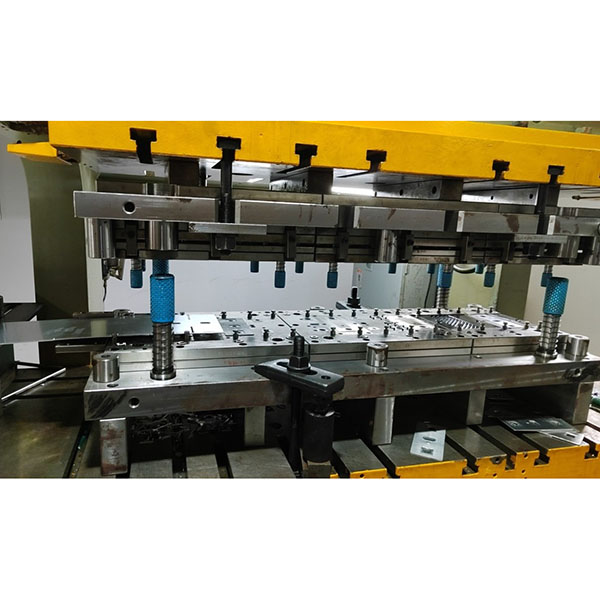
efficient cover plate stamping die design for volume runs
cover plate stamping die is used for efficient mass stamping of thin-sheet cover parts, forming them in one pass or in multiple steps through blanking, piercing, bending, embossing, or deep-drawing processes.
Description
cover plate stamping die is suitable for thin-sheet parts that require high dimensional accuracy and good appearance, such as electronic chassis covers, appliance panels, small automotive covers, and control panels.
main features of cover plate stamping die:
- high productivity: supports multi-station/progressive die designs with continuous feeding; single-stroke or multi-station dies can produce large quantities of qualified parts per day.
- high precision: dies are designed according to customer drawings with strict control of blanking clearance and bend springback compensation; typical tolerances can reach ±0.1 mm (depending on part size and processes).
- integrated processes: can combine blanking, piercing, flanging, bending, embossing, chamfering and other operations to reduce secondary processing.
- surface protection: die surfaces can be nitrided, carbo-nitrided, pvd coated or surface ground to extend life and reduce scratching.
- wide material compatibility: suitable for common thin-sheet materials such as cold-rolled steel, galvanized steel, stainless steel (sus304/sus301, etc.), and aluminum alloys.
die types and recommended scenarios:
- single-station/compound die: blanking and piercing are completed simultaneously, suitable for cover plates with simple structure and small to medium batch sizes.
- progressive/multi-station die: sequential forming across multiple stations with automatic feeding, suitable for high-volume production with low labor.
- transfer die: used for complex processes or larger parts, suitable for multi-process operations, precision deep drawing, or high-strength materials.
- deep-draw die: used when the cover has obvious recesses or requires deep forming, typically combined with hydraulic or specialized deep-drawing processes.
material and heat treatment recommendations:
- common die steels: skd11, h13, s45c (material selection varies by die component).
- critical cavities and punches are recommended to be quenched and tempered or surface nitrided; pvd coating can be applied when needed to resist sticking and extend life.
- guide components and material-holding parts can use wear-resistant alloys with surface treatments to extend interchange life and stability.
design and process control key points:
- blanking clearance: designed according to sheet thickness and material hardness (commonly 5%–15% of sheet thickness) to ensure section quality and reduce burrs.
- bend springback compensation: compensate for springback based on material properties and bend radius to ensure angle accuracy.
- blankholder and drawing force distribution: design blankholder force reasonably to prevent wrinkling and cracking.
- scrap removal and ejection: consider chip removal and ejection design for holes and small parts to avoid jamming.
- lubrication and cooling: for stainless steel or hard-to-form materials, use appropriate lubricants and control press speed to reduce scratching and sticking.
common application examples:
- rear covers of electronic devices, laptop or router housing panels.
- appliance control panels and decorative cover plates.
- small automotive cover plates, decorative trims and interior components.
- industrial control box doors, filter support plates, etc.