
 English
  Français
  Tiếng Việt
  Italiano
  Nederlands
  Türkçe
  Svenska
  Polski
  Română
  Latviešu
  한국어
한국어  Русский
  Español
  Deutsch
  Українська
  Português
  العربية
  Indonesian
  Čeština
  Suomi
Suomi  Eesti
Eesti  Български
  Dansk
Dansk  Lietuvių
  Bokmål
  Slovenčina
  Slovenščina
  Ελληνικά
  Magyar
  עברית
עברית 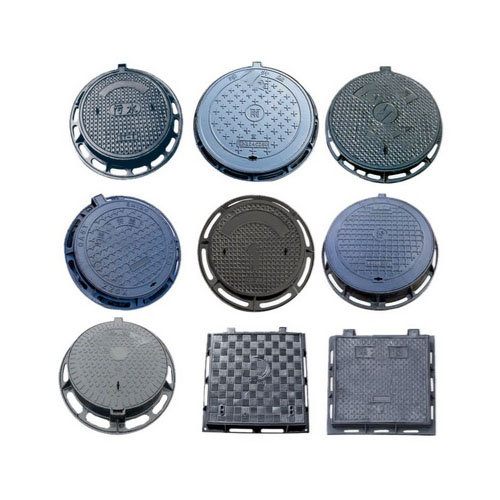
ductile iron manhole cover castings ensuring long life
ductile iron manhole cover castings are critical load-bearing and sealing components used in municipal roads, industrial parks, parking lots and sewerage systems.
Made from ductile iron and produced through optimized alloy design and refined casting processes, these products offer excellent compressive strength, impact resistance and corrosion resistance. Typical products include manhole covers, frames, locking devices and matching seats, suitable for various load classes such as pedestrian areas, light-duty, medium-duty and heavy-duty zones.
Main features and advantages:
- High load capacity: the ductile iron matrix has high strength and can withstand substantial static and dynamic loads, meeting the demands of roads and industrial sites.
- Excellent impact resistance and toughness: the material has good ductility and crack resistance, making it less prone to fracture under repeated loading and external impacts.
- Corrosion resistance and weatherability: surfaces can be treated with hot-dip galvanizing, powder coating or epoxy coatings to extend service life in humid or chemically aggressive environments.
- Anti-theft and safety design: anti-theft locks, sealing rings or anti-slip patterns can be added as required to enhance safety and theft resistance.
- Durable and low maintenance: compared with traditional castings, they have a longer service life, reducing replacement frequency and maintenance workload.
- Customizable: load ratings, opening methods, surface treatments and mating dimensions can be customized according to drawings, samples or on-site measurements to meet project production requirements.
Materials and process control:
ductile iron manhole cover castings typically use ductile iron (spheroidal graphite iron) as the material. Melting, chemical composition control, holding and appropriate pouring practices are employed to ensure the desired microstructure and mechanical properties. Key processes include mold design, melting and batching, pouring, cleaning, heat treatment (if necessary), machining and surface treatment. Strict control of chemical composition and cooling curves ensures a balanced combination of strength and toughness, meeting different load-class standards (for example, EN124).
Quality assurance and inspection:
- Chemical composition testing and MTC: use spectrometric analysis to verify composition and provide material test certificates.
- Mechanical property testing: conduct tensile, hardness and impact tests and provide test reports.
- Appearance and dimensional inspection: check for surface defects, dimensional tolerances and fit accuracy to ensure interchangeability.
- Static and dynamic load testing: perform load tests according to customer or industry standards to verify load-bearing capacity.
- Surface protection inspection: examine coating adhesion, plating thickness and corrosion resistance.
Typical applications:
Widely used in municipal roads, sidewalks, parking lots, factory floors, wastewater treatment plants and port terminals, and other scenarios that require reliable load-bearing and protection.