
 English
  Français
  Tiếng Việt
  Italiano
  Nederlands
  Türkçe
  Svenska
  Polski
  Română
  Latviešu
  한국어
한국어  Русский
  Español
  Deutsch
  Українська
  Português
  العربية
  Indonesian
  Čeština
  Suomi
Suomi  Eesti
Eesti  Български
  Dansk
Dansk  Lietuvių
  Bokmål
  Slovenčina
  Slovenščina
  Ελληνικά
  Magyar
  עברית
עברית 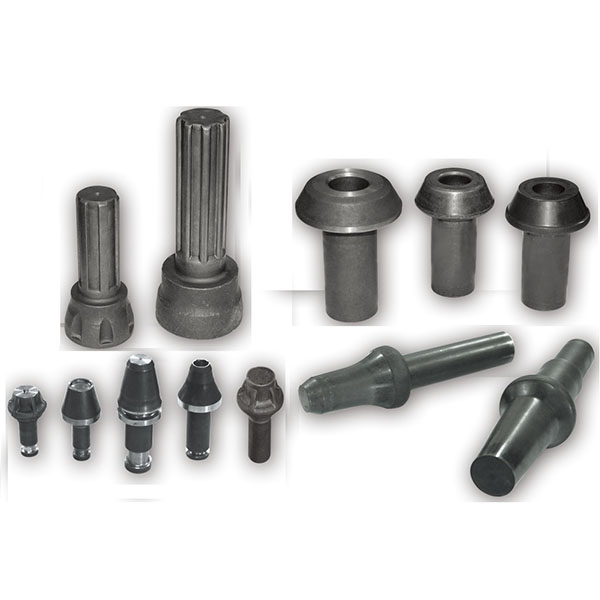
down-the-hole drill bits and forged mining accessories
Down-the-hole drill bits and other forged mining accessories are critical consumables and connectors specifically designed and manufactured for rock drilling and heavy-load mining conditions.
By combining forging processes with precision machining, parts are ensured to have a dense metal microstructure, continuous metal fiber flow and excellent mechanical properties, thereby enhancing wear resistance, impact resistance and service life, making them suitable for demanding environments such as mining, tunneling, engineering drilling and geological exploration.
Manufacturing process:
- Forging forming: Closed-die or open-die forging is used to optimize metal flow lines, reduce internal defects, increase microstructural density and mechanical uniformity, and ensure impact resistance and fatigue resistance.
- Heat treatment: Normalizing, quenching + tempering, carburizing or localized induction hardening are applied according to material composition and service conditions to achieve the required match between surface hardness and core toughness.
- Precision machining: Critical mating surfaces, guiding faces and installation interfaces are machined by CNC turning, milling, grinding and hole-making processes to ensure interchangeability and drilling accuracy.
- Carbide assembly: For bits that require welding or brazing of carbide teeth, strict heating and joining procedures are employed to ensure tooth bonding strength and service life.
- Surface strengthening: Optional processes such as shot peening and nitriding can be used to improve fatigue life; when necessary, microhardening or surface composite treatments are applied to resist abrasive wear.
Performance characteristics:
- High wear resistance: Material selection combined with surface treatments effectively resists rock abrasion, extending the service life of teeth and contact surfaces.
- Strong impact resistance: Forged microstructure and heat treatment improve parts’ resistance to cracking and fragmentation under impact loads.
- Excellent structural integrity: Continuous metal fiber flow and a dense microstructure reduce the risk of internal defects, enhancing fatigue life and reliability.
- High-precision fit: Precision machining ensures dimensional stability and interchangeability of mating surfaces, facilitating rapid onsite replacement and maintenance.
- Optimizable for operating conditions: By combining material selection, heat treatment and surface engineering, performance can be tailored to different rock formations and working conditions.
Applications:
Down-the-hole drill bits and other forged mining accessories are suitable for mining engineering, tunnel excavation, geological exploration, oil and gas drilling, engineering construction and other drilling and drivetrain components operating in high-wear, high-impact environments. Typical products include DTH drill bits, drill rods, drill collars, drill-tool connectors, sleeves and various forged mining accessories.