
 English
  Français
  Tiếng Việt
  Italiano
  Nederlands
  Türkçe
  Svenska
  Polski
  Română
  Latviešu
  한국어
한국어  Русский
  Español
  Deutsch
  Українська
  Português
  العربية
  Indonesian
  Čeština
  Suomi
Suomi  Eesti
Eesti  Български
  Dansk
Dansk  Lietuvių
  Bokmål
  Slovenčina
  Slovenščina
  Ελληνικά
  Magyar
  עברית
עברית 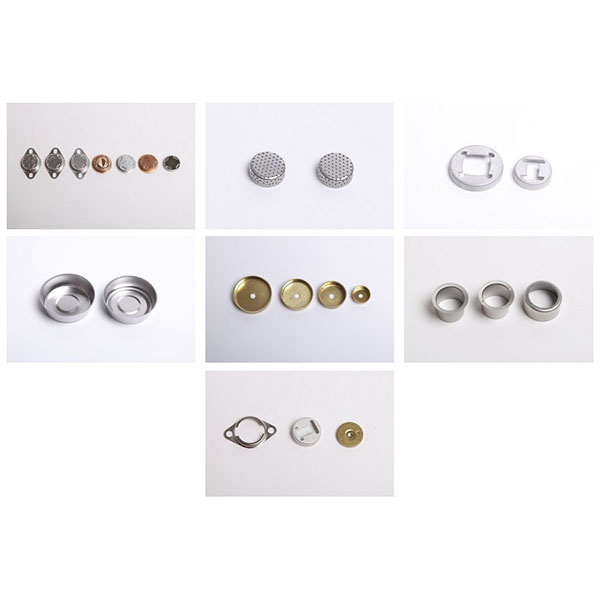
deep-drawn stampings for high-volume industrial production
deep-drawn stampings are cups, housings, blind boxes, and other deep-formed metal parts mass-produced by deep drawing and related stamping forming processes.
Description
deep-drawn stamping processes can achieve large forming depths while maintaining material strength, making them suitable for applications that require deep forming, stable dimensions, and high production capacity, such as automotive, electronics, home appliances, and industrial equipment.
main features of deep-drawn stampings:
- large-depth forming capability: capable of producing deep cups and housings in one or multiple drawing steps, reducing welding and assembly operations.
- controllable dimensions and high repeatability: use dedicated tooling and strict process parameter control to ensure part dimensions, geometric tolerances, and assembly fit consistency.
- high production capacity and cost efficiency: compatible with continuous or high-speed stamping lines, suitable for medium to large volume production with low unit cost and stable lead times.
- good material utilization: compared with machining or welding processes, deep drawing reduces material waste and improves structural integration.
- compatibility with various materials: deep drawing can be applied to thin sheet metals (such as cold-rolled steel, stainless steel, copper, and aluminum alloys), with flexible options for surface treatments.
applicable parts and application scenarios for deep-drawn stampings:
- automotive: lamp inner liners, oil cups, fuel system housings, small pump housings, etc.;
- electronics and electrical appliances: micro motor housings, inductor/transformer housings, sensor housings, etc.;
- home appliances and industrial equipment: compressor components, pump bodies, filter housings, heat shields, and structural parts, etc.;
- other situations requiring cups or deep shells, especially parts with requirements for sealing, strength, or integrated structure.
common materials and surface treatment recommendations:
- common materials: cold-rolled steel sheets (spcc, secc), stainless steel (e.g., 304, 430), copper and copper alloys, aluminum alloys, etc.; material thickness and forming depth should be evaluated together during the design phase.
- surface treatments: electroplating (nickel, tin, zinc, etc.), chemical plating, anodizing (for aluminum), painting, e-coating (electrophoretic coating), phosphating, etc.; choose processes based on corrosion resistance, conductivity, or aesthetic requirements.
- compatibility considerations: surface treatment processes must be compatible with the material and subsequent operations (such as welding or assembly) to avoid affecting dimensions, appearance, or functionality.
design and process control key points:
- material and thickness selection: choose suitable materials and sheet thickness based on drawing ratio, material ductility, and springback characteristics to avoid cracking or wrinkling.
- die design and staged-operation strategy: design die cavities, draw beads, and shoulder transitions properly; when necessary, apply multi-stage or preforming to reduce defect rates.
- springback and elastic recovery control: predict springback and design compensations to ensure stable finished dimensions.
- blank holding and lubrication management: optimize gripping and lubrication schemes to reduce friction, scratches, and material tearing risks.
- process parameter stability: control press speed, drawing force, holding force, and stripping/feed rhythm to ensure batch-to-batch consistency.
quality inspection and reliability assurance:
- full-process quality control: combine incoming material inspection, first-article verification, online process monitoring, and finished-product sampling inspection, focusing on dimensions, surface defects, and forming defects.
- functional testing: perform assembly fit checks, sealing tests, corrosion resistance and conductivity tests, etc., according to part function.
- traceability and improvement: establish batch and inspection records, promptly report production anomalies, and continuously optimize tooling and process parameters.