
 English
  Français
  Tiếng Việt
  Italiano
  Nederlands
  Türkçe
  Svenska
  Polski
  Română
  Latviešu
  한국어
한국어  Русский
  Español
  Deutsch
  Українська
  Português
  العربية
  Indonesian
  Čeština
  Suomi
Suomi  Eesti
Eesti  Български
  Dansk
Dansk  Lietuvių
  Bokmål
  Slovenčina
  Slovenščina
  Ελληνικά
  Magyar
  עברית
עברית 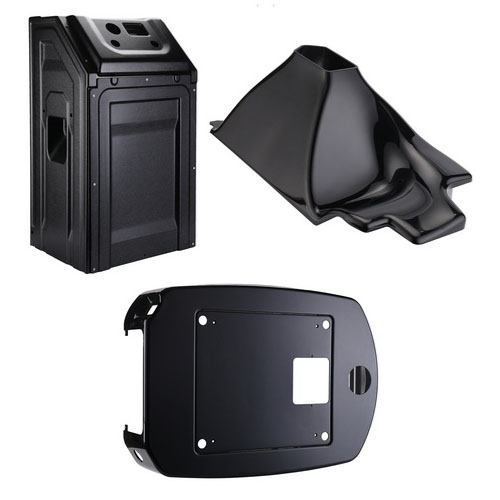
custom vacuum-formed irregular-shaped plastic housings
Vacuum-formed irregular-shaped plastic housings are produced by the vacuum forming process, which heats, stretches and draws thermoplastic sheets under vacuum, and combined with trimming, drilling and secondary processing, can achieve irregular-shaped housings with a smooth appearance, precise fit and functional features.
Description
Vacuum-formed irregular-shaped plastic housings are designed for products that have complex shapes, irregular dimensions, or require rapid customization, and are suitable for prototype validation, small-batch production, and medium-volume manufacturing scenarios.
Applicable materials:
- Common thermoplastic materials: ABS, PC, PET, PVC, HIPS, PP, PMMA, etc.; select appropriate grades based on impact resistance, temperature resistance, transparency, or flame-retardant requirements.
- Functional and composite sheets: antistatic, flame-retardant, antibacterial, or multi-layer co-extruded sheets can be selected to meet special performance requirements or regulatory compliance (e.g., medical-grade or food-grade materials).
Design and process key points for vacuum-formed irregular-shaped plastic housings:
- Forming feasibility assessment: analyze formability for deep cavities, sharp corners, and thin-wall areas; where necessary, optimize geometry, add transition fillets, or partition designs to avoid tearing and cracking.
- Wall thickness and reinforcement structures: reasonably distribute wall thickness and design ribs or local thickening at critical locations to improve strength, assembly fit, and deformation resistance.
- Demolding and locating design: design appropriate draft angles and locating references to ensure stable forming and ease of automated fixture pickup.
- Surface and appearance treatments: mirror finish, satin finish, textures, painting, pad printing, or other surface processes can be applied to meet branding and aesthetic requirements.
- Inserts and allowances: during mold design, provision can be made for embedded metal parts, boss locations, or assembly holes to improve subsequent assembly efficiency.
Advantages and features:
- Fast response and short lead time: short cycle from sample to pilot production, suitable for product iteration and validation.
- Cost advantage: compared with high-hardness injection molds, vacuum forming requires lower initial mold investment and is more cost-effective for small- to medium-volume production.
- Adaptability to complex shapes: suitable for forming large flat areas, irregular contours, and locally complex geometries.
- Easy functional integration: inserts, reserved mounting locations, or combinations with other materials can be designed to directly integrate functional components.
- Customizable surface: various textures and post-treatments can enhance appearance and meet different market positioning.
Typical application areas for vacuum-formed irregular-shaped plastic housings:
- Electronic and consumer product housings: handheld device covers, panel protectors, instrument enclosures, etc.
- Instruments and medical devices: equipment housings, face shields, tray-style liners, etc.
- Industrial and machinery protective parts: control panel covers, machine guards, junction box housings, etc.
- Display and gift housings: custom display pieces, gift packaging housings, and display covers.
- Custom fields: functional housings and protective covers with special shapes or integrated structures.