
 English
  Français
  Tiếng Việt
  Italiano
  Nederlands
  Türkçe
  Svenska
  Polski
  Română
  Latviešu
  한국어
한국어  Русский
  Español
  Deutsch
  Українська
  Português
  العربية
  Indonesian
  Čeština
  Suomi
Suomi  Eesti
Eesti  Български
  Dansk
Dansk  Lietuvių
  Bokmål
  Slovenčina
  Slovenščina
  Ελληνικά
  Magyar
  עברית
עברית 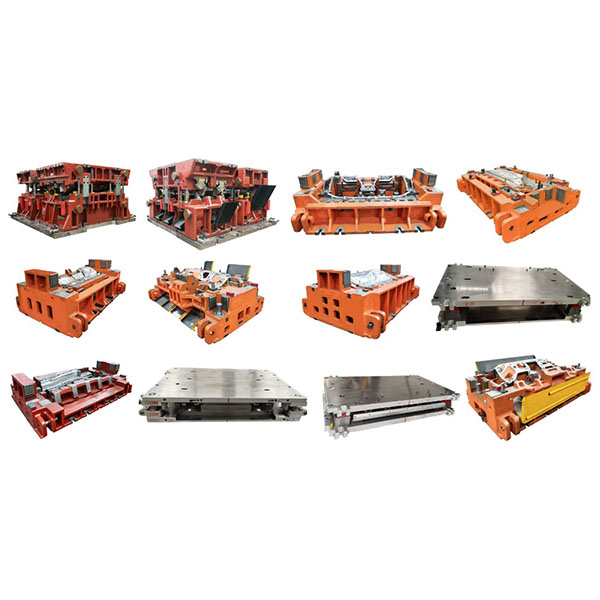
cold stamping die for weight enclosures and flange rings
Cold stamping dies, through precise die geometry and matched processes, can mass produce clips, brackets, housings, flanges and other metal parts at high speed and with high repeatability, and are widely used in the automotive, electronics, electrical appliances, home appliance, hardware and consumer goods industries.
Description
Cold stamping die is a specialized tool used to blank, bend, form, and assemble sheet metal at room temperature.
Main features of cold stamping dies:
- High efficiency for mass production: Compatible with high-speed presses and continuous production lines to achieve stable high output and meet medium to large volume production needs.
- Good dimensional consistency: Precision die design and strict machining tolerances ensure consistent part dimensions and geometric form, facilitating subsequent assembly.
- Multi‑operation integration: Can integrate blanking, bending, stretching, chamfering, forming, piercing and other operations in a single die or a progressive die, reducing manual work and secondary processing.
- Controllable cost: Low unit cost and high material utilization make it suitable for mass production; amortization over the die life lowers total production cost.
- Structure and material compatibility: Suitable for various cold forming metals (such as cold‑rolled steel, stainless steel, copper, aluminum alloys, etc.) with die and process parameters optimized for different materials.
Applicable parts and application scenarios for cold stamping dies:
- Automotive industry: spring clips, fasteners, brackets, retainers, shielding parts and other structural and functional components.
- Electronics and electrical appliances: battery holders, contact strips, shielding covers, connectors, small housings and frames.
- Home appliances and consumer goods: panel brackets, door hinge components, trim strips and fasteners.
- Hardware and industrial parts: flanges, gaskets, connection plates, spring plates and other thin sheet parts requiring high consistency.
- Suitable for scenarios requiring high repeatability, interchangeable fit, or large volume supply.
Common die types and structural highlights:
- Single operation die (single station die): Simple structure, suitable for mass blanking of single‑operation parts or small batch production validation.
- Progressive die: Completes multiple operations on a single feed line, high efficiency, suitable for large‑volume complex parts.
- Compound die: Performs multiple operations in the same station simultaneously, shortening cycle time but requiring high press rigidity.
- Continuous dies and drawing dies: Used for complex forming and deep drawing parts, requiring proper control of material flow and lubrication design.
Key points in die design and manufacturing:
- Materials and heat treatment: Select high‑strength die steels and apply appropriate heat treatment to achieve wear resistance and fracture toughness.
- Tolerances and fits: Strictly control guide posts, bushings, blanking clearances, and cutting edge radii to ensure cutting quality and tool life.
- Consider material flow and springback: Use proper blank layout, drawing ratios, and chamfer design to reduce wrinkling, cracking, and springback effects.
- Lubrication and scrap handling solutions: Design suitable lubrication paths and ejection/ scrap holes to reduce material sticking, scratching and jamming risks.
- Safety and maintenance accessibility: Reserve inspection and maintenance space and design quick‑change parts to facilitate daily maintenance and extend die life.