
 English
  Français
  Tiếng Việt
  Italiano
  Nederlands
  Türkçe
  Svenska
  Polski
  Română
  Latviešu
  한국어
한국어  Русский
  Español
  Deutsch
  Українська
  Português
  العربية
  Indonesian
  Čeština
  Suomi
Suomi  Eesti
Eesti  Български
  Dansk
Dansk  Lietuvių
  Bokmål
  Slovenčina
  Slovenščina
  Ελληνικά
  Magyar
  עברית
עברית 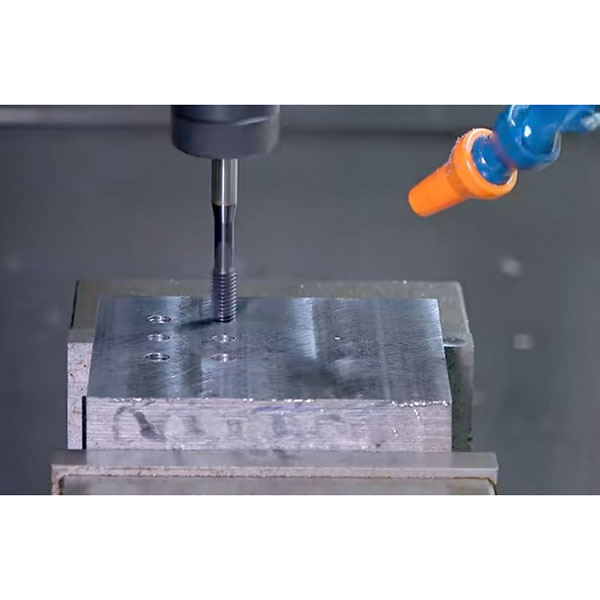
CNC tapping services for precision threaded components
CNC tapping (CNC Tapping) is the process of producing internal threads on CNC machines using taps, tapping heads or thread milling cutters. Please provide part drawings (2D, 3D), thread standards or detailed dimensions, tolerance requirements, material specifications and expected production quantities.
Description
We offer multiple process options including rigid tapping, tapping heads (floating tap holders) and thread milling, combined with mature program development and tool management, suitable for automated internal thread production from prototypes and small batches to large‑scale runs.
Process principles and implementation methods of CNC tapping:
- Rigid / synchronized tapping: the machine spindle and feed axis run synchronously to form the thread in one pass. This method is efficient and yields good thread accuracy but requires the machine to support rigid tapping functionality.
- Tapping head / floating tap holder: suitable for machines that do not support rigid tapping; mechanical compensation and buffering reduce the risk of tap breakage, improve stability, and facilitate flexible batch production.
- Thread milling: internal threads are milled on CNC machines using thread milling cutters. This is suitable for hard materials, larger diameters, or applications requiring high reliability, and also facilitates multi‑size processing and integrated chamfering.
Applicable materials and machining capabilities of CNC tapping:
- Supported materials: steels, hardened steels, stainless steels, aluminum alloys, copper and copper alloys, titanium alloys, nickel‑base alloys and other common conductive metals; for special materials we can provide process evaluation and recommendations.
- Thread types and accuracy: we cover common metric and imperial internal threads (M, UNC/UNF, etc.) as well as special non‑standard threads. Size range and achievable accuracy depend on thread diameter, material and chosen process; industrial‑level repeatability can be achieved.
- Deep holes and thin‑walled parts: by optimizing chip evacuation, cutting fluid and feed strategies, we can stably process deep‑hole tapping and thin‑walled components, reducing fixture deformation and the risk of workpiece damage.
Process advantages of CNC tapping:
- High efficiency: drilling and tapping are completed on the same machine, reducing operations and setups and improving production efficiency.
- High accuracy and consistency: rigid tapping and precise tool compensation ensure consistent thread position and dimensions to meet assembly fit requirements.
- Automation and traceability: suitable for automated loading/unloading and production monitoring of CNC cells, facilitating mass production and quality traceability.
- Strong adaptability: parameters (speed, feed, reverse‑pecking for chip evacuation, etc.) can be optimized for different materials and specifications to balance efficiency and surface quality while minimizing tap breakage.
Quality control and inspection:
- Before machining: drawing and thread requirement review, fixture and tool checks, and trial cuts/adjustments.
- During machining: spot checks of critical dimensions and real‑time monitoring (feeds, speeds, cutting forces or alarm signals), with production data recorded for traceability.
- After machining: use go/no‑go gauges, thread ring/plugs, coordinate measuring machine (CMM) or thread gauges to inspect pitch, radial tolerances and geometric form; provide inspection reports and traceability documents when required.
Common application scenarios for CNC tapping:
- Automotive manufacturing: high‑precision internal threads in engine blocks, transmission components and body fasteners.
- Machinery and power equipment: thread machining for gearbox housings, pump bodies, valve bodies and similar parts.
- Aerospace and medical devices: fasteners and interfaces with high requirements for precision and reliability.
- Molds and die sets: locating threads and assembly fasteners for mold components.