
 English
  Français
  Tiếng Việt
  Italiano
  Nederlands
  Türkçe
  Svenska
  Polski
  Română
  Latviešu
  한국어
한국어  Русский
  Español
  Deutsch
  Українська
  Português
  العربية
  Indonesian
  Čeština
  Suomi
Suomi  Eesti
Eesti  Български
  Dansk
Dansk  Lietuvių
  Bokmål
  Slovenčina
  Slovenščina
  Ελληνικά
  Magyar
  עברית
עברית 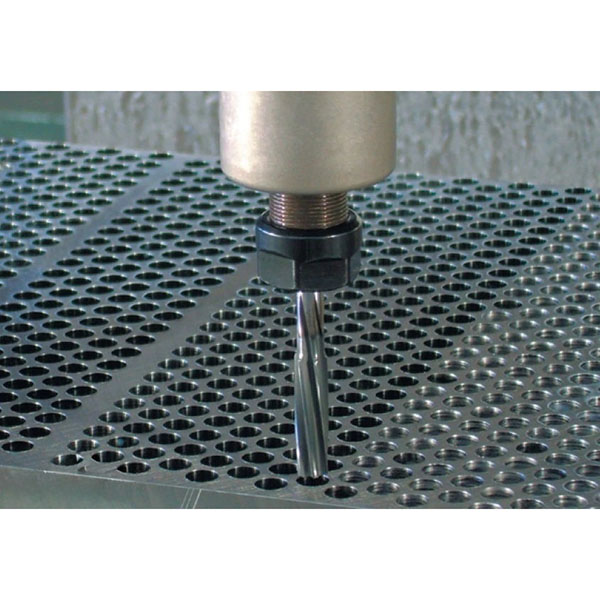
CNC reaming for precision bore finish and accuracy
CNC reaming is a high‑precision finishing operation for pre‑machined holes. Using CNC machines with specialized reamers, it performs small‑allowance cutting to elevate hole diameter size, roundness, coaxiality, and surface roughness to higher grades.
Description
Compared with relying solely on drilling or boring, CNC reaming consistently achieves smaller dimensional variation and better surface quality. It is commonly used for final sizing of critical features such as bearing bores, locating holes, and fit holes.
Core advantages of CNC reaming:
- Excellent geometric accuracy: roundness, cylindricity, and coaxiality are more stable, enabling high‑precision fits and assembly.
- Stable process: specialized reamer geometry and CNC feed ensure steady cutting loads, reducing the risk of wall tearing and chatter marks.
- Strong cost efficiency: compared with fine boring, reaming typically offers better cost‑performance and cycle time in small to large batch production.
Materials and hole types suitable for CNC reaming:
- Metals: carbon steel, alloy steel, stainless steel, aluminum alloys, copper alloys, titanium alloys, etc.
- Non‑metals: engineering plastics (e.g., POM, PA, PEEK) and composites; tool material and geometry must be matched accordingly.
- Hole types: through holes and blind holes; can be used to finish a specific section of a stepped hole. Blind‑hole reaming requires chip evacuation allowance and control of bottom over‑cut.
- Pre‑machining requirements: a qualified pre‑drilled/pre‑bored hole is needed before reaming, with appropriate stock allowance and good hole position and perpendicularity.
Equipment:
- Machines: rigid CNC vertical/horizontal machining centers or precision drill presses. Spindle axial runout and thermal stability must be controlled.
- Toolholders and clamping: high‑precision collet chucks/heat‑shrink holders to reduce radial runout; use guide bushings when necessary to improve initial guidance accuracy.
- Cooling and lubrication: external coolant, internal coolant, or MQL can be used. For difficult‑to‑machine materials, high‑pressure internal coolant and extreme‑pressure cutting oil are recommended.
Tool types:
- Solid reamers: HSS, cobalt HSS (HSS‑Co), and carbide.
- Adjustable reamers: for fine size tuning, suitable for multiple sizes in small quantities.
- Coatings: TiN, TiAlN, AlCrN, DLC, etc., to increase wear resistance and reduce adhesion.
- Guidance and chamfering: appropriate rake angles, relief angles, and guide land length improve stability and surface finish.
Cutting parameter selection:
- Speed (n): select low‑to‑medium spindle speeds based on material and tooling to avoid vibration and burning.
- Feed (f): use a steady, small feed to ensure surface finish and size accuracy. Reaming typically uses constant axial feed; interrupted cutting is prohibited.
- Cutting fluid: maintain continuous, adequate supply for cooling and lubrication.
Process flow reference:
- Pre‑machined hole preparation: drill or bore to leave the planned stock allowance, ensuring hole position and perpendicularity. Remove burrs and chips.
- Tool setting and verification: measure actual reamer diameter and runout; confirm program coordinates and fixture datum.
- Machining and retraction: feed continuously to target depth; keep the spindle running during retraction to avoid scratching the bore wall.
- Cleaning and inspection: deburr and remove chips. Use plug gauges, air gauges, or CMM to inspect dimensions and geometry.
- Process optimization: fine‑tune feed, cooling, and tool compensation based on inspection results; establish SPC and compensation strategies in mass production.
Application scenarios for CNC reaming:
- Precision fit holes: e.g., bearing seat bores, pin holes, locating pin holes, and sliding fit holes.
- Hydraulic and pneumatic system bores: require low roughness and good roundness to reduce leakage and wear.
- Medical and aerospace parts: small‑hole arrays with strict dimensional and surface requirements.
- Jigs and fixtures: ensure repeatable clamping accuracy and consistency.
Differences between CNC reaming, drilling, and boring:
- Drilling: hole‑making method with high efficiency but limited dimensional and surface quality.
- Boring: uses a boring tool to correct hole position and size; highly flexible, suitable for large holes and geometric error correction.
- Reaming: focuses on final sizing and surface finishing, consistently achieving high dimensional accuracy and surface quality; often used in conjunction with the first two.