
 English
  Français
  Tiếng Việt
  Italiano
  Nederlands
  Türkçe
  Svenska
  Polski
  Română
  Latviešu
  한국어
한국어  Русский
  Español
  Deutsch
  Українська
  Português
  العربية
  Indonesian
  Čeština
  Suomi
Suomi  Eesti
Eesti  Български
  Dansk
Dansk  Lietuvių
  Bokmål
  Slovenčina
  Slovenščina
  Ελληνικά
  Magyar
  עברית
עברית 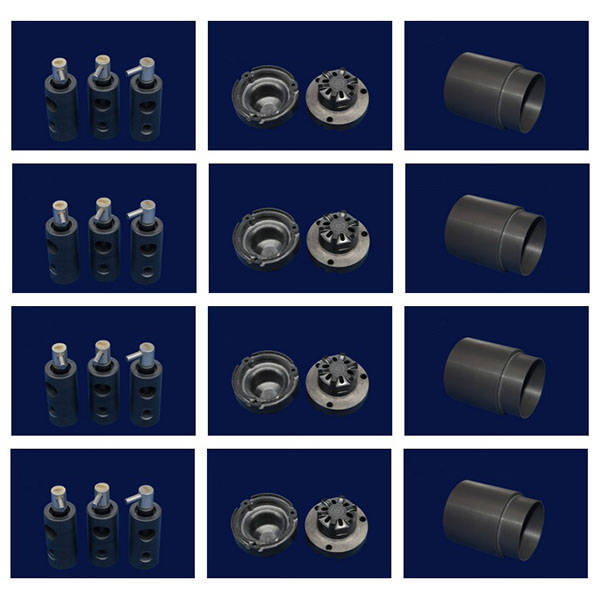
CNC machining of silicon carbide ceramics SiC for use
We provide professional CNC machining services for silicon carbide (SiC) ceramics, delivering stable and controllable manufacturing of precision ceramic parts for applications requiring high hardness, high wear resistance, high temperature resistance, and excellent thermal conductivity.
Description
Silicon carbide exhibits extremely high hardness and significant brittleness, placing strict demands on cutting tools and process parameters. With specialized machinery, diamond tooling, and advanced process flows, we can deliver SiC parts with complex geometries and high precision requirements.
Equipment and process capabilities:
- Machines and tooling: Equipped with high-rigidity CNC grinding and milling equipment, rigid cast beds, and precision spindles, and employing diamond grinding wheels and diamond tools for material removal, suitable for precision machining of high-hardness ceramics.
- Machining methods: We support diamond grinding, ultrasonic vibration assisted machining (USM), precision milling, wire EDM (for specific geometries), and subsequent fine polishing and chemical mechanical polishing (CMP) to achieve mirror or low-roughness surfaces.
- Cooling and chip evacuation: We employ efficient cooling and lubrication strategies and dedicated chip evacuation designs to control machining heat and prevent surface cracking or chipping, ensuring processing stability and tool life.
- Post-processing: We provide necessary heat treatments and surface sealing, coating, or functionalization treatments (e.g., wear-resistant coatings, conductive or thermally conductive coatings) to improve density, surface performance, and service life.
Materials and typical applications:
- Applicable materials: Dense sintered SiC, reaction-bonded SiC (RB‑SiC), and SiC composites (material grades and process routes selected according to customer requirements).
- Typical applications: Wear-resistant parts, mechanical seals, bearing components, heat exchanger parts, tool cores, semiconductor and optical substrates, aerospace structural components, and other precision parts requiring high-temperature resistance, corrosion resistance, and high thermal conductivity.
Design recommendations and manufacturing considerations:
- Brittleness considerations: SiC is a hard and brittle material; designs should avoid ultra-thin walls and sharp internal corners. Reasonable fillets are recommended to reduce stress concentration and fracture risk.
- Manufacturability optimization: We recommend performing DFM evaluations during the design phase, arranging wall thicknesses and support structures appropriately, limiting the depth of extremely deep or fine through-holes, and using assembly of multiple parts when necessary to reduce machining difficulty and cost.
- Tooling and fixturing: Use dedicated diamond tools and robust fixturing, optimize cutting parameters and feed strategies, and apply appropriate cooling methods to reduce thermal damage and chipping.