
 English
  Français
  Tiếng Việt
  Italiano
  Nederlands
  Türkçe
  Svenska
  Polski
  Română
  Latviešu
  한국어
한국어  Русский
  Español
  Deutsch
  Українська
  Português
  العربية
  Indonesian
  Čeština
  Suomi
Suomi  Eesti
Eesti  Български
  Dansk
Dansk  Lietuvių
  Bokmål
  Slovenčina
  Slovenščina
  Ελληνικά
  Magyar
  עברית
עברית 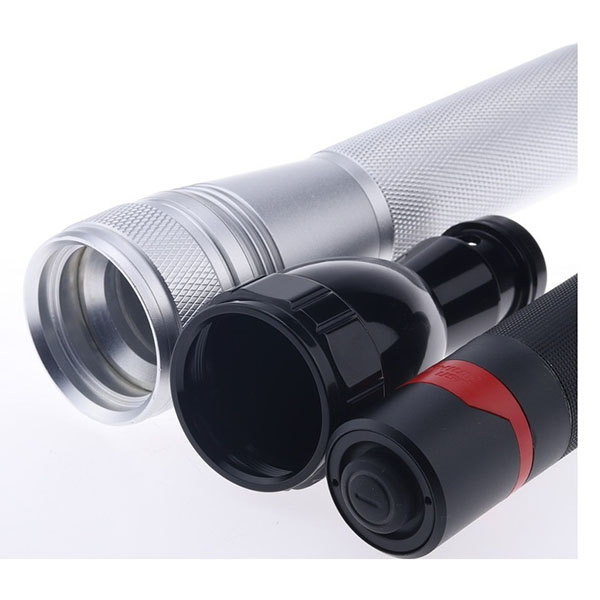
CNC machining of flashlight housings for rugged lighting
We provide high‑precision CNC machining services for consumer and industrial flashlight housings, covering single prototypes to mass production, focusing on dimensional fits, thread and sealing‑surface accuracy and consistency of surface treatments to ensure product reliability and user experience.
Description
Flashlight housings are critical structural components of portable lighting products, responsible for battery compartment positioning, head mounting, heat dissipation and protection.
Machining capabilities and equipment:
- Main equipment: precision CNC lathes, turn‑mill composite centers, vertical and horizontal five‑axis machining centers and automated loading/unloading systems, equipped with high‑rigidity tool holders, indexing heads and online measurement stations.
- Machining capabilities: external diameters, internal bores, sectional contours and complex thread machining, deep‑hole drilling, stable thin‑wall machining, groove and heat‑dissipation rib machining, chamfering and countersinking, mirror surface finishing, supporting completion of multiple critical features in one setup.
- Automation and inspection: supports bar‑feed, automated loading/unloading, online measurement feedback and tool life management to improve batch consistency and production efficiency.
Material support and blank forms for CNC machining flashlight housings:
- Supported materials: aluminum alloys (e.g., 6061, 6063, 7075), stainless steels (e.g., 303, 304, 316), brass, titanium alloys and engineering plastics (e.g., POM, PEEK), selected according to strength, weight and appearance requirements.
- Blank forms: bar stock, extruded or drawn blanks, milled blanks, forged or cast blanks and customer‑supplied blanks (blank). We can recommend blanks based on housing geometry and machining allowance to reduce cutting volume and control costs.
Tools, fixturing and key process points:
- Tools and fixturing: use coated carbide tooling, micro‑cutting tools and specialized anti‑vibration fixtures; fixture design balances clamping repeatability with heat dissipation and thermal deformation control.
- Key processes: prioritize completing critical positioning and thread and sealing‑surface machining in one setup; turn‑mill composite machining reduces secondary clamping errors; adopt segmented finishing and clamping‑compensation strategies to ensure mating dimensions.
- Thermal management and deformation control: optimize cutting parameters and control cutting heat input during finishing stages; when necessary apply annealing or stress‑relief treatments to reduce deformation.
Threads, sealing surfaces and surface quality control:
- Threads and fits: support internal and external thread turning, tolerance and fit control and fastener fit verification; provide roll‑threading or cut‑thread options.
- Sealing surfaces: achieve low roughness and geometric tolerance control on sealing faces that contact o‑rings or gaskets to meet air‑tightness and waterproofing requirements.
- Surface roughness and treatments: can achieve low‑roughness surfaces (process dependent, up to Ra ≤ 0.4 µm), and provide anodizing, sandblasting, polishing, plating, painting and powder coating to meet corrosion resistance, wear resistance and appearance consistency requirements.
Assembly, testing and reliability verification:
- Assembly services: modular pre‑assembly of battery compartments, switches, seals and reflectors; control fastening torque and perform functional pre‑inspection as required; offer ready‑to‑install delivery options.
- Testing items: perform waterproof and dustproof testing (IP rating tests), air‑tightness and leakage testing, drop and impact testing, vibration testing, torque and twist verification and surface wear testing, and provide test reports per customer requirements.