
 English
  Français
  Tiếng Việt
  Italiano
  Nederlands
  Türkçe
  Svenska
  Polski
  Română
  Latviešu
  한국어
한국어  Русский
  Español
  Deutsch
  Українська
  Português
  العربية
  Indonesian
  Čeština
  Suomi
Suomi  Eesti
Eesti  Български
  Dansk
Dansk  Lietuvių
  Bokmål
  Slovenčina
  Slovenščina
  Ελληνικά
  Magyar
  עברית
עברית 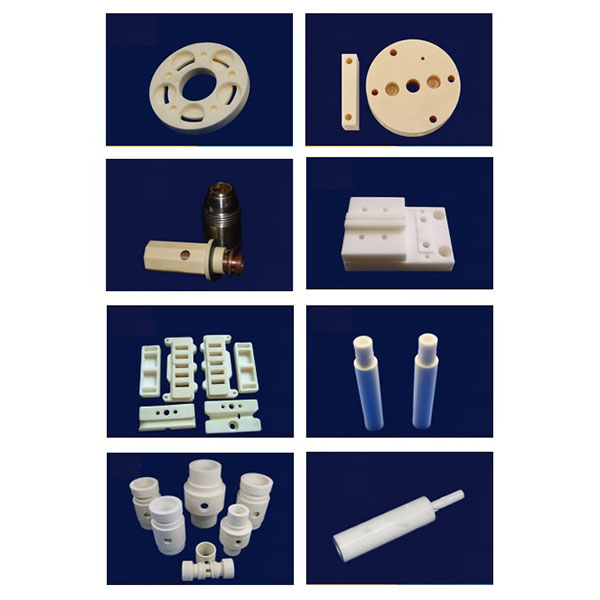
CNC machining of ceramic valves for precision control
We provide high‑precision CNC machining services for ceramic valves, covering critical components such as valve bodies, valve cores, valve seats, sealing surfaces, and internal flow channels.
Description
With specialized machine tools, diamond tooling, and mature processes, we achieve precise forming, tight sealing, and long-term corrosion and wear resistance tailored to the high hardness and brittleness of ceramic materials, making our solutions suitable for fluid control equipment in chemical processing, pharmaceuticals, petroleum, semiconductors, food, and high-temperature/highly corrosive service conditions.
Equipment and tooling:
- Machines and rigidity: Equipped with high-rigidity five-axis and three-axis CNC milling machines, precision turn‑mill centers, external cylindrical grinders, and specialized micro‑machining equipment to meet the positioning and repeatability accuracy requirements for complex multi‑face and internal flow‑channel machining.
- Tools and consumables: Using diamond end mills, diamond turning tools, diamond grinding wheels, and ultra‑hard coated tools, we optimize tool geometry and cutting and grinding parameters for ceramics to reduce chipping and cracking risks.
- Auxiliary equipment: High‑precision spindles, ultra‑high‑pressure cooling and filtration systems, vibration suppression devices, and dedicated fixtures to ensure machining stability and surface integrity.
Main machining methods for CNC machining of ceramic valves:
- Precision milling and sculpting: Used for roughing and finishing complex valve body shapes, flow‑channel contours, and sealing contact surfaces; five‑axis linkage enables completion of complex geometries in a single setup.
- Lapping, grinding and honing: Used to bring valve seats, valve cores, and sealing surfaces to strict geometric tolerances and high surface quality.
- Ultrasonic vibration assisted machining (USM) and diamond grinding: Reduce cutting forces, limit crack propagation, and improve surface integrity on brittle ceramics; suitable for thin‑walled or slender structures.
- EDM (electrical discharge machining) and micro‑machining: Employed for high‑precision forming of hard‑to‑machine features such as complex internal cavities, narrow slots, or deep holes.
- Polishing and chemical mechanical polishing (CMP): Achieve mirror‑grade or ultra‑low roughness sealing and sliding contact surfaces to enhance sealing performance and service life.
Cooling, chip evacuation, and fixturing:
- Cooling strategies: Use controlled cooling and filtered lubricants to reduce local heat buildup and prevent cracks or dimensional/form drift caused by thermal stress.
- Chip evacuation and cleaning: Optimize toolpaths and chip evacuation routes, supplemented by efficient cleaning procedures, to prevent abrasive particles from embedding in sealing surfaces or flow channels and creating leakage risks.
- Fixturing solutions: Custom rigid and flexible fixtures, concentric supports, and multi‑point support designs to ensure thin‑walled and complex‑shaped parts do not deform during machining.
Machinable materials and typical applications for CNC machining of ceramic valves:
- Typical materials: Dense alumina (Al2O3), silicon nitride (Si3N4), silicon carbide (SiC), aluminum nitride (AlN), and functional ceramic composite materials.
- Typical applications: Valves for corrosive or abrasive media transfer, precision metering valves, valve seat and valve core assemblies, sanitary valves, and valves for high‑temperature or semiconductor process applications.