
 English
  Français
  Tiếng Việt
  Italiano
  Nederlands
  Türkçe
  Svenska
  Polski
  Română
  Latviešu
  한국어
한국어  Русский
  Español
  Deutsch
  Українська
  Português
  العربية
  Indonesian
  Čeština
  Suomi
Suomi  Eesti
Eesti  Български
  Dansk
Dansk  Lietuvių
  Bokmål
  Slovenčina
  Slovenščina
  Ελληνικά
  Magyar
  עברית
עברית 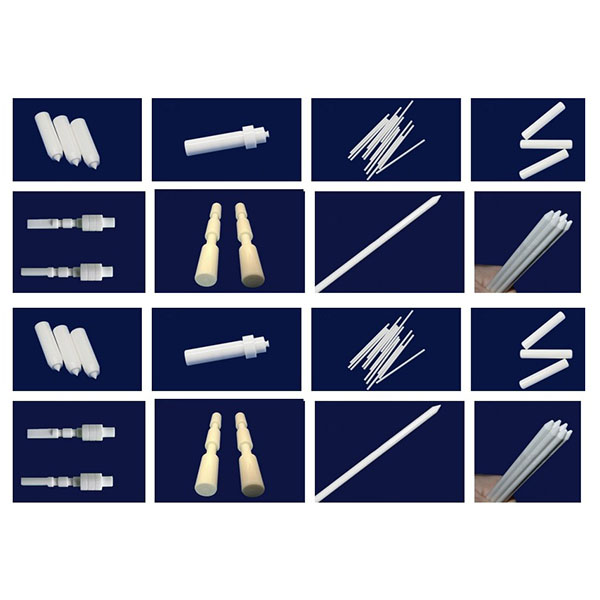
CNC machining of ceramic rods for instrument parts
We provide professional CNC machining services for ceramic rods, delivering precision cylindrical geometries, bore, and end-face machining for high-hardness, brittle materials.
Description
With specialized machinery, diamond tooling, and mature process flows, we can meet the stringent requirements for concentricity, roundness, diameter tolerances, and surface finish of ceramic rods in fields such as electronics, semiconductors, precision instruments, medical devices, aerospace, and high-temperature industries.
Equipment and tooling:
- Machines: Equipped with high-rigidity CNC lathes, external cylindrical grinders, centerless grinders, and precision grinding/polishing equipment for processing ceramic rods of various diameters and lengths.
- Tools and consumables: Using diamond turning tools, diamond grinding wheels, and dedicated wear parts, tool geometry and grinding parameters are optimized for the high hardness of ceramics to reduce chipping and cracking risks.
- Auxiliary equipment: High-precision spindles, dynamic balancing systems, and vibration suppression designs ensure machining process stability.
Main machining methods for CNC machining of ceramic rods:
- Precision turning and external cylindrical grinding: Used for initial machining and near-size control, combined with rigid clamping to achieve axial positioning and end-face machining.
- Centerless grinding and centered grinding: Suitable for high-efficiency outer diameter machining and dimensional consistency control, especially for batch processing of small-diameter/long rods.
- Ultrasonic vibration assisted machining (USM) and diamond grinding: Reduce cutting forces, limit crack propagation, and improve surface integrity.
- Fine polishing and ultra-precision finishing: Mechanical polishing or chemical mechanical polishing (CMP) processes are used to achieve mirror-grade or ultra-low roughness surfaces.
- Micropore and internal bore machining: High-precision internal holes are achieved through micro-drilling, reaming/grinding, or special coating-guided processes.
Cooling, chip evacuation, and fixturing for CNC machining of ceramic rods:
- Cooling strategies: Use controlled cooling and lubrication media (including necessary coolant formulations) to reduce local heat buildup and prevent cracks caused by thermal stress.
- Chip evacuation and cleaning: Optimize toolpaths and chip evacuation routes, combined with efficient cleaning processes to prevent abrasive particle embedding and surface contamination.
- Fixturing solutions: Custom rigid or flexible fixtures, concentric supports, and end-face supports to ensure concentricity and minimize rod deformation.
Machinable materials and typical applications:
- Typical materials: Dense alumina (Al2O3), silicon nitride (Si3N4), silicon carbide (SiC), aluminum nitride (AlN), and other dense ceramics and ceramic composites.
- Typical applications: Precision shafts, insulating rods, sensor supports, thermocouple sheaths, wear-resistant pins, valve cores, semiconductor mechanical supports, and medical device components.
Design recommendations and manufacturing considerations:
- Length-to-diameter ratio control: Long slender rods are prone to deflection and vibration; it is recommended to consider appropriate diameter ranges or segmented machining in the design stage to improve yield.
- Support and clamping guidelines: For long-rod machining, use intermediate supports or center supports to avoid eccentricity and form errors caused by single-end clamping.
- Fillets and end-face treatment: Apply chamfers or appropriate fillets to end-face contact areas and hole edges to reduce stress concentration and facilitate assembly and coating.
Quality control and inspection:
- Inspection equipment: Equipped with coordinate measuring machines (CMM), roundness testers, surface roughness testers, microscopes, and, when necessary, nondestructive testing equipment for dimensional, form, and surface inspection.
- Traceability and documentation: Provide first article inspection reports (FAI), material certificates, and batch records to support integration with customers’ quality management systems.