
 English
  Français
  Tiếng Việt
  Italiano
  Nederlands
  Türkçe
  Svenska
  Polski
  Română
  Latviešu
  한국어
한국어  Русский
  Español
  Deutsch
  Українська
  Português
  العربية
  Indonesian
  Čeština
  Suomi
Suomi  Eesti
Eesti  Български
  Dansk
Dansk  Lietuvių
  Bokmål
  Slovenčina
  Slovenščina
  Ελληνικά
  Magyar
  עברית
עברית 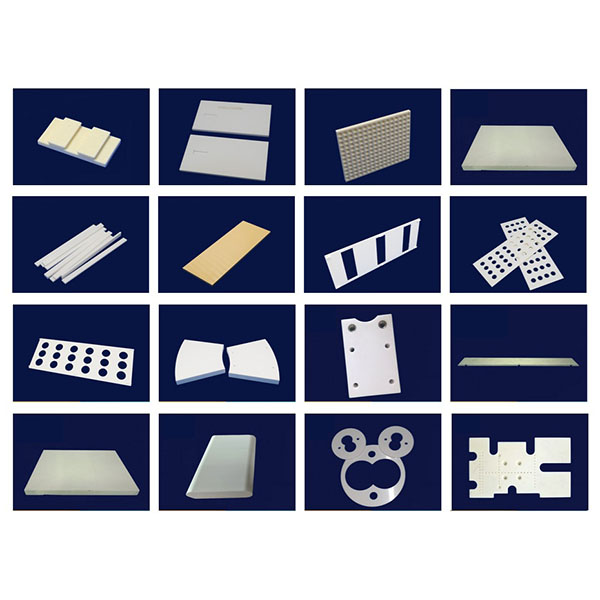
CNC machining of ceramic plates for precision parts
We provide professional CNC machining services for ceramic plates, achieving high flatness, low surface roughness, and stable dimensional control for various functional ceramic materials (such as alumina, silicon nitride, silicon carbide, aluminum nitride, etc.).
Description
Through specialized machinery, diamond tooling, and strict process flows, we can meet the demanding requirements for the dimensional accuracy and surface quality of ceramic plates in the fields of electronics, semiconductors, industrial machinery, optical substrates, and high-temperature thermal management.
CNC machining of ceramic plates, equipment and tooling:
- 1. Machines and rigidity: High-rigidity CNC milling/grinding machines and precision spindles are used to ensure vibration suppression and geometric stability during machining.
- 2. Tools and consumables: Diamond tools, diamond grinding wheels, and dedicated fixtures are used to accommodate the high hardness of ceramic materials, improving material removal efficiency while reducing chipping and cracking.
CNC machining of ceramic plates, main machining methods:
- 1. Precision milling and surface grinding: Used to achieve plate flatness and thickness consistency.
- 2. Ultrasonic vibration assisted machining (USM) and diamond grinding: Improve cutting efficiency and reduce the risk of crack formation.
- 3. Wire EDM and micromachining: High-precision forming for complex slots, through-holes, or locating structures.
- 4. Polishing and chemical mechanical polishing (CMP): Used to achieve mirror-grade or ultra-low roughness surfaces to meet optical or semiconductor application requirements.
Cooling, chip evacuation, and fixturing:
- 1. Cooling strategies: Use controlled cooling and lubrication media to reduce heat buildup, preventing thermal cracks and thermal stress.
- 2. Chip evacuation design: Dedicated chip evacuation systems and optimized toolpaths to avoid particle embedding and surface damage.
- 3. Fixturing solutions: Custom rigid fixtures and flexible supports to minimize deformation and ensure repeatable positioning accuracy.
Machinable materials and application scenarios:
- 1. Typical materials: Dense alumina (Al2O3), silicon nitride (Si3N4), silicon carbide (SiC), aluminum nitride (AlN), and other dense ceramics and ceramic composites.
- 2. Typical applications: Semiconductor substrates and supports, optical and sensor substrates, high-temperature thermal management plates, wear-resistant liners, precision mechanical assemblies, and electrical insulation structural components.
Design recommendations and manufacturing considerations:
- 1. Plate thickness and support: Avoid overly thin plate designs or provide adequate support during machining to reduce deformation and fracture risk.
- 2. Fillets and chamfers: Apply appropriate fillets to holes and slots to reduce stress concentration and improve manufacturing yield.
- 3. Part segmentation and assembly: For extremely deep/thin or complex internal cavity structures, it is recommended to machine in multiple parts and assemble afterward to improve yield and reduce cost.