
 English
  Français
  Tiếng Việt
  Italiano
  Nederlands
  Türkçe
  Svenska
  Polski
  Română
  Latviešu
  한국어
한국어  Русский
  Español
  Deutsch
  Українська
  Português
  العربية
  Indonesian
  Čeština
  Suomi
Suomi  Eesti
Eesti  Български
  Dansk
Dansk  Lietuvių
  Bokmål
  Slovenčina
  Slovenščina
  Ελληνικά
  Magyar
  עברית
עברית 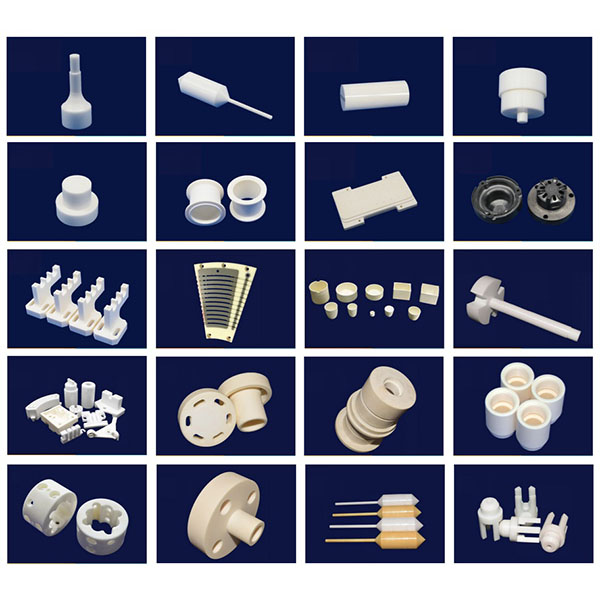
CNC machining of ceramic parts for advanced systems needs
We provide professional CNC machining services for ceramic parts, and have developed comprehensive machining processes and quality control systems tailored to the high hardness and brittleness of ceramic materials.
Description
Through precision machine tools, diamond tooling, and dedicated fixtures, we achieve stable production of complex shapes, precise dimensions, and excellent surface performance. These capabilities are widely applied in the manufacture of functional components for medical devices, semiconductors, aerospace, chemical processing, fluid control, sensors, and in high‑temperature, highly corrosive environments.
Equipment and tooling:
- Machines and rigidity: Equipped with high‑rigidity CNC lathes, three‑axis and five‑axis CNC machining centers, internal and external cylindrical grinders, honing machines, precision turn‑grind compound machines, ultra‑precision vertical and horizontal grinders, and specialized micro‑machining equipment to ensure positioning and repeatability accuracy for long shafts, thin‑walled parts, complex cavities and micro‑feature components.
- Tools and consumables: Using diamond turning tools, diamond end mills, diamond grinding wheels, polycrystalline diamond (PCD) and ultra‑hard coated tools, together with specialized fine‑grinding consumables and cooling/lubrication media, we optimize tool geometry and cutting/grinding parameters for different ceramic materials to reduce chipping, cracking and thermal damage risks.
- Auxiliary systems: High‑precision spindles, temperature‑controlled/thermostatic fixtures, ultra‑high‑pressure cooling and particulate filtration systems, vibration suppression devices, online measurement and automated loading/unloading systems to enhance machining stability and production consistency.
Main machining methods for CNC machining of ceramic parts:
- Precision turning and boring: Used for datum establishment, blank dressing and near‑net forming to ensure axis concentricity and end‑face datum conformity.
- Diamond grinding and honing: Through rough and finish grinding and honing processes achieve strict radial tolerances, cylindricity and low surface roughness, suitable for sealing surfaces, mating surfaces and bearing contact surfaces.
- Ultrasonic vibration assisted machining (USM) and ultra‑fine grinding: Reduce cutting forces in brittle ceramic cutting, suppress crack propagation, and improve edge integrity of thin‑walled and slender structures.
- EDM and micro‑machining: For forming and trimming complex internal cavities, narrow spaces, deep grooves and micro‑holes that are difficult to reach.
- Polishing and chemical mechanical polishing (CMP): Produce mirror‑grade finishes on sealing surfaces or high‑requirement mating faces to further reduce friction, improve sealing, and extend service life.
Cooling, chip evacuation, and fixturing:
- Cooling strategies: Use controlled cooling, particulate filtration and adaptive lubricants, combined with temperature‑controlled fixtures or cooling circulation systems to avoid local temperature rise that could induce thermal stress and dimensional drift.
- Chip evacuation and cleaning: Optimize toolpaths and chip evacuation routes, equipped with ultrasonic and high‑pressure cleaning, air blow‑off and vacuum chip removal processes to prevent particles embedding in machined surfaces or affecting precision fits.
- Fixturing solutions: Custom mandrels, concentric support fixtures, multi‑point supports and elastic locating designs to reduce clamping stress, prevent deformation of thin‑walled parts and ensure machining repeatability.
Machinable materials and typical applications for CNC machining of ceramic parts:
- Machinable materials: Alumina (Al2O3), silicon nitride (Si3N4), silicon carbide (SiC), aluminum nitride (AlN), zirconia (ZrO2) and various functional ceramic composites and coated ceramics.
- Typical applications: Medical device components, semiconductor manufacturing parts, sensor protection elements, valve and fluid control components, wear‑ and corrosion‑resistant parts, nozzles, precision insulating components, and functional structural parts for special service conditions.