
 English
  Français
  Tiếng Việt
  Italiano
  Nederlands
  Türkçe
  Svenska
  Polski
  Română
  Latviešu
  한국어
한국어  Русский
  Español
  Deutsch
  Українська
  Português
  العربية
  Indonesian
  Čeština
  Suomi
Suomi  Eesti
Eesti  Български
  Dansk
Dansk  Lietuvių
  Bokmål
  Slovenčina
  Slovenščina
  Ελληνικά
  Magyar
  עברית
עברית 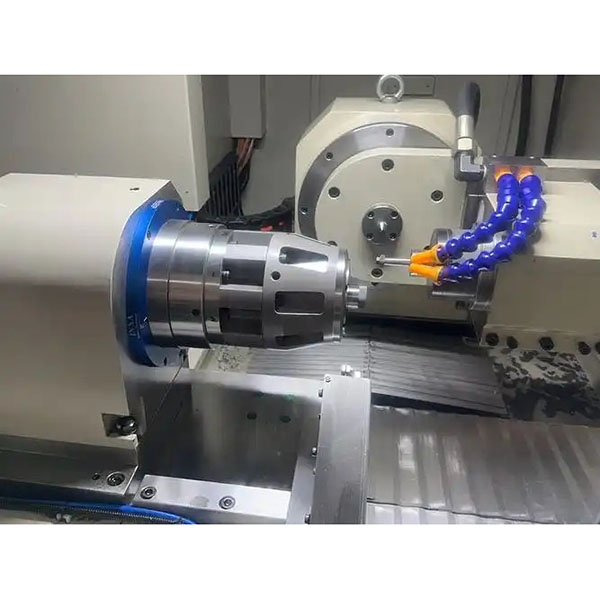
CNC grinding for precision tolerances and fine finish
CNC grinding is a precision finishing method that uses CNC grinders and precision wheels to remove minute amounts of material from workpiece surfaces, widely applied to achieve stringent dimensional tolerances, geometric accuracy, and superior surface roughness.
Description
CNC grinding can cover multiple types including external cylindrical grinding, internal grinding, centerless grinding, surface grinding, profile/form grinding, and tool grinding. It is suitable for high‑precision machining of difficult materials such as metals, ceramics, and hard alloys.
Core advantages of CNC grinding:
- High dimensional and geometric accuracy: routinely stable at ±0.005–±0.01 mm or better. Control of roundness, cylindricity, flatness, and perpendicularity is more reliable.
- Low surface roughness: surface roughness Ra typically reaches 0.2–0.8 μm (depending on material and wheel), meeting requirements for bearings, seals, and sliding fits.
- Stability and consistency: CNC programs, constant speed/constant surface speed, and wheel compensation ensure batch consistency and reduce process fluctuation.
- Suitable for hard‑to‑machine materials: reliably machines hardened steel, hard alloys, ceramics, titanium alloys, nickel‑based alloys, and other high‑hardness or brittle materials.
- Economical and reliable: improves pass rate at the final finishing stage, reducing subsequent correction and rework costs.
Applicable materials and workpiece types for CNC grinding:
- Materials: quenched/tempered steels, stainless steel, aluminum alloys (wheel matching required), copper alloys, titanium alloys, nickel‑based alloys, hard alloys (carbides), ceramics, glass ceramics, etc.
- Workpieces: shafts, sleeves, sliding elements, mold contours, cutting tools and gauges, valve cores and seats, pump shafts and rotors, linear guide sliders, precision flat parts, etc.
Grinding wheel types:
- Aluminum oxide (A/WA): general steel parts and medium‑hardness materials.
- Silicon carbide (GC): suitable for cast iron, non‑ferrous metals, and brittle materials.
- Diamond (D): suitable for hard alloys (cemented carbide), ceramics, and glass ceramics.
- Cubic boron nitride (CBN): suitable for hardened steels and high‑hardness ferrous materials; high efficiency and low wear.
Equipment and configuration:
- Equipment: CNC external/internal grinders, CNC centerless grinders, CNC surface grinders, CNC profile grinders, CNC tool grinders. Prefer high‑rigidity spindle, precision guideways, and a stable cooling system.
- Bond types: vitrified (ceramic), resin, metal, electroplated, etc. Chosen according to material and accuracy requirements.
- Wheel grit size and hardness: fine grit and moderate hardness for finish grinding; coarser grit and higher hardness for rough grinding. Must balance self‑sharpening and shape retention.
- Clamping and support: three‑jaw/four‑jaw chucks, centers and center holes, centerless supports and regulating wheels. For thin‑wall parts use special fixtures and low‑stress clamping.
Process parameter settings:
- Wheel surface (peripheral) speed: set according to wheel material and workpiece material, generally 20–45 m/s; CBN/diamond can be higher (follow equipment and wheel safety specifications).
- Feed and depth of cut: small depths and steady feed to control heat and deformation. Finish grinding uses micro cuts and spark‑out.
- Cooling and lubrication: sufficient, directed cooling to reduce thermal deformation and burning risk. Filtration precision ensures coolant cleanliness.
Process flow reference:
- Pre‑processing: review drawings and tolerances; confirm material heat treatment state; select wheel type, grit, and bond; set coolant and filtration level.
- Clamping and alignment: ensure coaxiality and datum consistency; for shaft parts ensure center hole accuracy and rigid support.
- Rough and finish grinding: remove allowance in rough grinding, then finish grind to size; for critical surfaces use stop‑spark measurement and programmed compensation.
- Dressing and compensation: use diamond dressers or in‑process dressing to maintain wheel form and sharpness; program dimensional compensation and thermal drift compensation.
- Inspection and deburring: perform in‑process/offline dimensional and geometric checks; carry out slight deburring and cleaning when necessary.
Quality control and inspection:
- Dimensions and geometry: use micrometers, bore gauges, air gauges, plug/ring gauges, roundness testers, and CMM to inspect size, roundness, flatness, coaxiality, etc.
- Surface quality: use a roughness tester for Ra/Rz; microscopic inspection for burn, cracks, and scoring.
- Stability: establish SPC statistics, first‑piece/in‑process/final inspection routines; record wheel life and dressing cycles, monitor thermal drift and dimensional trends.
- Traceability: provide inspection reports, material and heat treatment batch records, and process parameter logs.
Common application scenarios for CNC grinding:
- Bearings and sealing components: raceways, rings, sealing fit surfaces.
- Hydraulic and pneumatic: valve cores, valve seats, sliding fit parts where roundness and roughness are critical.
- Tools and gauges: relief faces, form grinding, and gauge sizing.
- Molds and precision profiles: cavities, cores, guide pillars and bushings, inserts, and precision flats.
- Aerospace and medical: critical mating surfaces and micro features in high‑strength, high‑hardness materials.
- Electronics and semiconductors: precision flats, guide rails, and heat sink contact surfaces.
Comparison of CNC grinding with turning, milling, and different grinding types:
- Turning and milling: high efficiency and flexible shape generation, but final precision and surface quality usually inferior to fine grinding; often combined with grinding.
- External/internal grinding: used for high‑precision sizing and geometric control of rotating surfaces and bores.
- Centerless grinding: high‑efficiency, high‑consistency solution for batch shaft part processing.
- Surface grinding: ensures flatness and surface roughness; suitable for datum surfaces.
- Profile and tool grinding: achieves complex curves/profiles and precise tool geometries with high accuracy forming and resharpening.