
 English
  Français
  Tiếng Việt
  Italiano
  Nederlands
  Türkçe
  Svenska
  Polski
  Română
  Latviešu
  한국어
한국어  Русский
  Español
  Deutsch
  Українська
  Português
  العربية
  Indonesian
  Čeština
  Suomi
Suomi  Eesti
Eesti  Български
  Dansk
Dansk  Lietuvių
  Bokmål
  Slovenčina
  Slovenščina
  Ελληνικά
  Magyar
  עברית
עברית 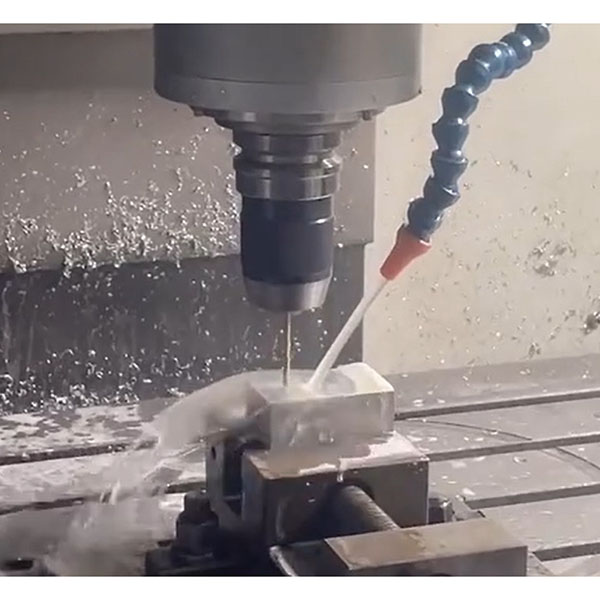
CNC drilling services for precision holes and accuracy
CNC drilling is a fundamental cutting process that, via programming of spindle speed, feed, tool path, and cooling method on numerically controlled machine tools, such as machining centers, CNC drilling machines, turn-mill compound machines, and gantry machining centers, performs initial hole creation or additional hole machining on materials.
CNC drilling is suitable for through holes, blind holes, deep holes, stepped holes, counterbored (spot-faced) holes,
chamfered holes, and thread root (tapping) holes, covering multiple hole types. Compared with manual machining or
ordinary drill presses, CNC drilling offers high positional accuracy, good repeatability, traceable process
parameters, and strong batch consistency. It is an important preceding operation for subsequent boring, reaming,
tapping, and assembly positioning.
Core advantages of CNC drilling
- High hole position accuracy and repeatability: Numerical control positioning and multi-axis interpolation reduce
cumulative error, making it ideal for hole systems and hole arrays. - Automation and efficiency: Batch multi-hole machining, automatic tool change via tool magazine, and cycle macro
programs improve productivity. - Capability for multiple hole types: Shallow holes, deep holes, thread root holes, stepped holes, counterbored
holes, pre-enlarging (preparatory) holes. - Good linkage with subsequent finishing: Establishes initial geometric datum for boring, reaming, honing,
tapping, and sleeve pressing. - Machinable materials: Carbon steel, alloy steel, cast iron, stainless steel, aluminum alloys, copper alloys,
nickel-based alloys, titanium alloys, engineering plastics, etc. - Data traceability: Parameters, tool life, and batch results can be recorded for quality control and SPC
analysis.
Typical application scenarios for CNC drilling
- Mechanical components: Flange through holes, coupling holes, locating holes, oil passage holes.
- Mold manufacturing: Cooling channel holes, ejector pin holes, guide pillar pre-drill holes, threaded insert root
holes. - Automotive and power systems: Housing holes, bracket mounting holes, engine accessory holes.
- Electronics and instruments: Ventilation (heat dissipation) holes, mounting holes, precision small hole arrays.
- Aerospace and medical: Holes in high-strength alloy structural parts, precision assembly holes.
- Hydraulic and pneumatic: Pre-drilling for valve body and manifold oil passage holes.
Hole types and characteristics
- Through holes, blind holes: Standard straight hole formation.
- Deep holes: Large length-to-diameter ratio (L/D); may use step drilling or gun drilling strategies.
- Stepped holes, compound holes: Segmented diameters for fits and accommodating fasteners.
- Counterbored holes, counterbore plus chamfer: For screw head embedding and flush appearance.
- Thread root (tapping) holes: Controlled diameter and depth to ensure thread quality in subsequent tapping.
- Taper holes, enlarged (pre-enlarged) holes: Preparatory features for positioning, sealing, or interference fits.
- Locating holes, datum holes: References for subsequent fixturing or precision machining.
Equipment types
- Vertical machining center: High flexibility, suitable for multi-variety small to medium parts.
- Horizontal machining center: Rotary table enables multi-face hole machining and coaxial control of hole systems.
- CNC gantry machine: Multi-hole machining on large plates and structural parts.
- Specialized CNC drilling machine: High-efficiency batch hole arrays and high-speed small hole machining.
- Turn-mill compound machine: Completes radial, side, and threaded holes on rotational parts in one setup.
- Gun drilling and deep hole machines: Suitable for extra-long deep holes, oil passages, and high straightness
requirements.
Tooling and holding systems
- Twist drills (HSS, solid carbide, coatings such as TiAlN, AlCrN, DLC): General hole creation.
- Solid carbide gun drills, deep hole drills: Long guiding structure for stable chip evacuation.
- Indexable insert drills: Large holes, high efficiency, and lower cost per piece.
- Step drills, combination drills: Form multiple diameter segments in a single pass, reducing tool changes.
- Spot drills, center drills: Prevent wandering of larger drills and improve positional accuracy.
- Boring tools, hole enlargement tools (as corrective/pre-finishing): Adjust diameter after drilling.
- Pre-reamers before tapping, chamfer tools: Prepare entrances for threads and fit holes.
- Toolholders and clamping: BT/HSK holders, shrink-fit, hydraulic holders reduce radial runout. Through-coolant
holders enhance chip evacuation and tool life in deep holes.
Reference process flow for CNC drilling
- Technical review: Confirm diameter, tolerance, depth, positional/coaxiality requirements, material and hardness,
subsequent operations. - Datum selection and fixturing: Choose stable locating surfaces/holes. For multi-face hole systems, plan sequence
to reduce cumulative error. - Programming and parameter setup: Spindle speed, feed, cutting depth, step (peck) drilling strategy, cooling
method. - Centering and pre-drill: Center drill / spot drill to prevent sliding and wandering of large-diameter drills.
- Rough drilling: Use drills with suitable geometry and flute design; control chip shape (segment or curled) for
evacuation. - Deep hole strategy (if needed): Peck withdrawal plus high-pressure internal coolant to prevent long chip
wrapping and thermal damage. - Preparation for finishing: Leave proper allowance depending on whether boring or reaming follows (e.g., reaming
allowance 0.1 to 0.3 mm; boring allowance per final accuracy requirement). - Hole enlargement, semi-finishing (optional): Improve roundness and approach final size.
- Tapping root hole, counterbore, chamfer: Process according to thread standards and fastener specifications.
- In-process measurement (optional): Touch probe or manual gauges to verify key hole positions and depths.
- Deburring and cleaning: Remove edge burrs and cross-hole residues to ensure assembly and fluid passage.
- Final inspection and recording: Archive size, positional accuracy, depth, and surface condition.
Key process parameter references for CNC drilling
- Spindle speed: Based on material and drill diameter (aluminum allows higher RPM; hardened materials need reduced
speed and selection of carbide). - Feed rate: Adjust with hole diameter and tool material. Excessive feed causes chipping or rough walls; too low
increases friction heating. - Peck depth: For deep holes or gummy materials, control single feed increment for chip evacuation (e.g., each
peck 1 to 3 times drill diameter or staged by depth). - Cooling method: External plus internal; high-pressure internal coolant preferred for deep holes. Prevent
adhesion and burning in stainless and nickel-based alloys. - Tool runout: Control radial runout ≤ 0.02 mm (may be stricter before precision finishing).
- Tool life monitoring: Record number of holes or cutting time. Replace when diameter goes out of tolerance,
surface scoring appears, or chips turn blue/black.
Comparison of CNC drilling with other hole-making processes
- Drilling: First, rapid hole creation; economical and efficient. Positional and form accuracy influenced by tool
rigidity and guidance. - Boring: Corrects coaxiality/position and diameter accuracy on existing holes; suitable for large holes or tight
form tolerances. - Reaming: Improves diameter size and surface finish; limited ability to correct position; typically follows
drilling or boring. - Tapping: Produces internal threads in a prepared root hole; requires accurate hole diameter and depth.
- Honing, burnishing (rolling): Further improves surface roughness and micro-geometry (used for high-precision fit
holes). - EDM, laser micro-drilling: Supplements drilling for extremely small holes or difficult-to-machine materials.
Common challenges and control points
- Chip evacuation difficulty: Deep holes, gummy materials (stainless steel, aluminum) need high-pressure internal
coolant and peck strategies. - Drill walking, hole position drift: Use center drills and short drills, then transition to longer drills. Ensure
fixturing rigidity and monitor tool wear. - Burrs on hole wall and poor surface finish: Optimize feed and speed; use sharp coated tools and perform timely
deburring. - Tool wear and chipping: Establish life thresholds, monitor chip color and diameter trends. For hard materials,
prioritize fine-grain carbide or internal coolant drills. - Thermal effects and expansion: Monitor dimensional drift during continuous batch production and apply minor tool
compensation adjustments.