
 English
  Français
  Tiếng Việt
  Italiano
  Nederlands
  Türkçe
  Svenska
  Polski
  Română
  Latviešu
  한국어
한국어  Русский
  Español
  Deutsch
  Українська
  Português
  العربية
  Indonesian
  Čeština
  Suomi
Suomi  Eesti
Eesti  Български
  Dansk
Dansk  Lietuvių
  Bokmål
  Slovenčina
  Slovenščina
  Ελληνικά
  Magyar
  עברית
עברית 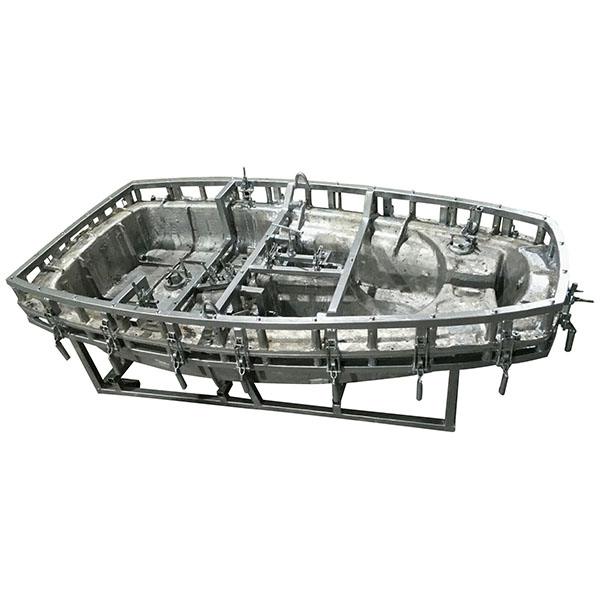
boat hull rotational molding mold for custom production
Boat hull rotational molding molds are specifically designed for rotational molding processes and are used for one-piece production of kayaks, canoes, recreational boats, outboard components for small powerboats, and other small- to medium-sized hull structural parts.
Description
Boat hull rotational molding molds are typically manufactured from high-strength aluminum alloys or steels, precisely machined and surface-treated. The interior is a hollow cavity that, during the rotational heating and cooling process, ensures the molten plastic evenly coats the mold cavity, thereby achieving uniform wall thickness, fewer seams, and seamless, welded-free integral hull formation.
Main features of the boat hull rotational molding mold:
- Strong process compatibility: hollow cavity design optimized for rotational molding processes, suitable for common rotational molding materials such as PE, LLDPE, and HDPE.
- Excellent one-piece forming: achieves seamless hulls with uniform wall thickness, improving structural integrity and buoyancy and safety.
- High-precision manufacturing: employing CNC milling, surface polishing, and machining inspection processes to ensure mold fit accuracy and molding consistency.
- Balance of lightness and durability: aluminum alloy molds are lighter for easier handling and installation; steel molds offer wear and impact resistance for long-life continuous production.
- Balanced thermal control and cooling: mold designs consider heat distribution and cooling efficiency to shorten cycle times and enhance production yield.
- Easy disassembly and repairability: molds adopt split or jointed designs for convenient disassembly, maintenance, and local repairs, reducing maintenance costs.
- Customizable: bespoke design and manufacturing services can be provided according to hull shape, wall thickness requirements, and mold opening dimensions.
Applications:
- Kayaks, canoes, single- and double-person recreational boats, and other small hulls.
- Single-piece or half-piece molding of fishing boats, lifeboats, pontoons, and dock components.
- Hull covers, deck components, storage compartments, and cockpit shells.
- Small- to medium-volume and batch production needs for education, sports, and tourism industries.