
 English
  Français
  Tiếng Việt
  Italiano
  Nederlands
  Türkçe
  Svenska
  Polski
  Română
  Latviešu
  한국어
한국어  Русский
  Español
  Deutsch
  Українська
  Português
  العربية
  Indonesian
  Čeština
  Suomi
Suomi  Eesti
Eesti  Български
  Dansk
Dansk  Lietuvių
  Bokmål
  Slovenčina
  Slovenščina
  Ελληνικά
  Magyar
  עברית
עברית 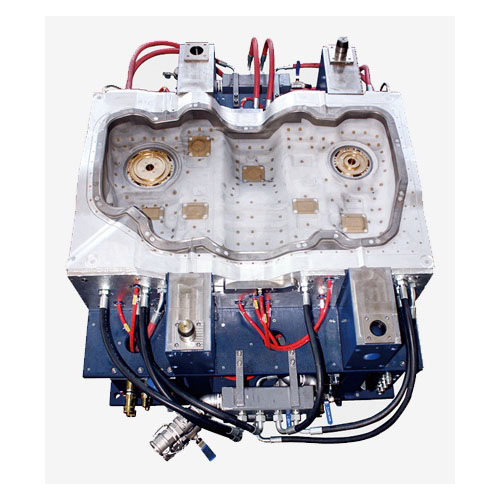
blow mold for vertical sewage storage tank fabrication
A blow mold is a specialized forming tool for hollow plastic products. It inflates a heated, molten plastic parison (preform tube) inside the mold to achieve lightweight, seamless, one-piece construction.
Description
Blow Mold Product Overview
Blow molds are suitable for producing water tanks, sewage storage tanks, chemical storage tanks, packaging containers, pipe fittings, and similar products, with the following features:
Features
- Structural advantages: Through well-designed cavities and wall-thickness control, they achieve uniform walls, reinforcing ribs, anti-deformation zones, threaded or flanged openings, and other details to enhance compression and impact resistance.
- Production efficiency: Blow molding offers short cycles and high automation, enabling stable mass production and shorter delivery times.
- Lightweight and durable: Products are lighter than metal or concrete options, easy to handle and install, and feature shock, fatigue, and wear resistance.
- Corrosion and weather resistance: Materials can be formulated for chemical resistance, UV resistance, low-temperature performance, or flame retardancy to meet outdoor, semi-buried, or special safety requirements.
- Sealing and leak prevention: One-piece molding reduces seams and weld points, lowering leakage risk; paired with sealing covers, gaskets, or dedicated interfaces to ensure safe storage and transport.
- Customization: The mold can reserve positions for inlets/outlets, vents, service ports, level interfaces, lifting lugs, mounting bases, or internal baffles, flow guides, filtration, and aeration components to support multi-stage pretreatment or inline systems.
- Application scenarios: Widely used for distributed sewage collection and temporary storage, on-site or temporary construction water and sewage treatment, emergency and mobile facilities, and industrial or civil storage requiring lightweight and corrosion resistance.
For customization of capacity, interface specifications, dimensions, ribbing methods, or material formulations, provide parameters based on daily and peak flow, site height, and footprint constraints so the mold can be optimized accordingly.