
 English
  Français
  Tiếng Việt
  Italiano
  Nederlands
  Türkçe
  Svenska
  Polski
  Română
  Latviešu
  한국어
한국어  Русский
  Español
  Deutsch
  Українська
  Português
  العربية
  Indonesian
  Čeština
  Suomi
Suomi  Eesti
Eesti  Български
  Dansk
Dansk  Lietuvių
  Bokmål
  Slovenčina
  Slovenščina
  Ελληνικά
  Magyar
  עברית
עברית 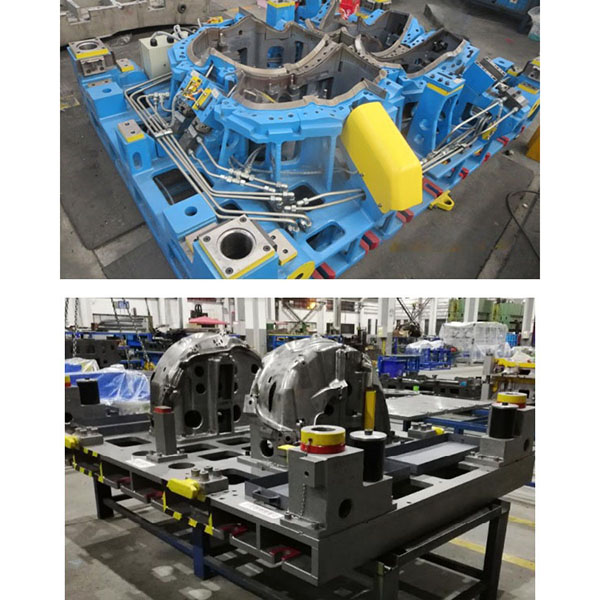
blanking die for wheel covers and decorative trim parts
The blanking die for wheel covers is a die specifically designed to blank wheel cover blanks from coil or sheet. It targets high‑precision edge cutting and stable blank dimensions, providing consistent and interchangeable blanks for subsequent deep drawing, forming, trimming, and assembly operations.
Description
The blanking die for wheel covers is suitable for pre-production operations of wheel covers made from cold-formable materials such as aluminum alloys, cold‑rolled steel, and stainless steel, and is widely used in the mass manufacture of automotive wheel covers, wheel decorative caps, and related trim parts.
Main features of the blanking die:
- High-precision blanking: By optimizing cutting edges and blanking clearances, it ensures high consistency of blank dimensions and peripheral geometry, reducing the amount of rework in subsequent processes.
- High capacity and stability: Compatible with continuous feeding systems and high-speed presses to meet stable production requirements for medium to large volumes.
- Strong material adaptability: Cutting edges, clearances, and scrap handling can be adjusted for different material grades and thicknesses such as aluminum alloys, cold‑rolled steel, and stainless steel.
- Durable and easy to maintain: Uses high‑strength tool steels and appropriate heat treatment to improve tool wear resistance; modular or quick‑change blade designs facilitate on-site maintenance and replacement.
- Excellent material utilization: Reasonable strip nesting reduces scrap rate and lowers per‑part cost.
Applicable parts and application scenarios:
- Primarily used for blanking and cutting wheel cover (wheel covers) blanks.
- Also applicable to production of flat blanks with similar shapes or sizes, such as decorative caps and housings.
- Suitable for batch production scenarios that require stable dimensions and high accuracy for subsequent forming or assembly (automotive OEM parts, secondary processing suppliers, etc.).
Materials and process recommendations:
- Typical materials: Aluminum alloys (common series like 1xxx/5xxx/6xxx), cold‑rolled steel, pre‑plating electrogalvanized steel, and stainless steel sheet.
- Thickness range: Common sheet thickness depends on part design (for example, 0.6–2.0 mm is a typical range); specific values should be confirmed according to vehicle specifications and forming requirements.
- Surface protection: To avoid scratches or burrs during blanking, use protective film or appropriate lubrication at feed and clamping points, and where necessary coordinate with downstream surface treatments (painting, plating, anodizing, etc.).
Key points in die design and manufacture:
- Cutting edge and blanking clearance: Precisely set according to material grade and thickness to ensure blanking quality and extend tool life.
- Locating and clamping structure: Design reliable locating pins, hold‑down devices, and feed guides to prevent material shift, wrinkling, or lifting, ensuring blanking consistency.
- Scrap and waste control: Plan the drop area and scrap winding/discharge methods to avoid jamming and strip breaks.
- Blade and die core materials: Select wear‑resistant tool steels and apply appropriate heat treatments and surface treatments (such as nitriding or sulfiding) to improve durability.
- Quick maintenance design: Modular blades and easily replaceable wear parts shorten downtime for maintenance.
Quality control and die tryout verification:
- First‑article inspection: During tryout, inspect the first blanks for profile, critical dimensions, and burrs to verify cutting clearance and locating accuracy.
- Online monitoring and sampling: Establish regular dimensional sampling and online monitoring (piece counting, anomaly alarms) to detect blade wear or feeding abnormalities promptly.
- Integrity inspection: Inspect blanks for edge integrity, burrs, and surface scratches to ensure smooth downstream forming operations.