
 English
  Français
  Tiếng Việt
  Italiano
  Nederlands
  Türkçe
  Svenska
  Polski
  Română
  Latviešu
  한국어
한국어  Русский
  Español
  Deutsch
  Українська
  Português
  العربية
  Indonesian
  Čeština
  Suomi
Suomi  Eesti
Eesti  Български
  Dansk
Dansk  Lietuvių
  Bokmål
  Slovenčina
  Slovenščina
  Ελληνικά
  Magyar
  עברית
עברית 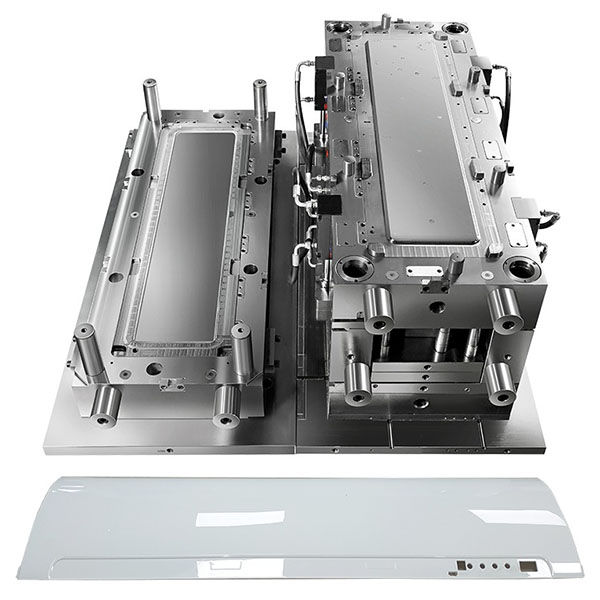
air conditioner panel injection mold for precise fit
air conditioner panel injection molds are used for mass production of air conditioner panel parts, including indoor unit front panels, control panels, and outlet panels, and accommodate various engineering plastics and surface texture requirements.
Description
air conditioner panel injection molds emphasize dimensional accuracy, surface consistency, and assembly fit, support efficient injection molding of complex structural features such as snaps, ventilation holes, button positioning, and embedded decorative inserts, and are widely used in the supply chains of residential and commercial air conditioners and accessories.
typical applications:
- indoor unit front panels, control panels, and display panels.
- air duct panels, outlet grilles, and guide vanes.
- combined structural parts with snaps, button positions, and decorative insert slots.
- appearance and functional parts that require precise assembly faces and high-quality surface textures.
product features and customer value:
- high-precision dimensional control: ensure compatibility with display modules, button mechanisms, and housings, reducing subsequent assembly adjustments.
- excellent surface appearance: support various textures (glossy, matte, fine leather texture) and color consistency to meet visual and tactile requirements.
- structural integration: integrate snaps, stud positions, and insert slots into mold design to reduce secondary assembly costs.
- stable mass-production performance: by optimizing gating and cooling design, shorten cycle time, improve yield, and reduce unit production cost.
- durability and reliability: material selection and mold cooling control ensure dimensional and mechanical stability of parts under thermal cycling and long-term use.
common materials and material selection recommendations:
- common materials: abs, pc, abs, abs+p, pc, pp, ppe, tpe, etc.
- material selection considerations: mechanical strength, heat resistance, flame retardant rating, weather resistance, yellowing resistance, and surface paintability. for indoor decorative use emphasize appearance and durability; for long-term exposure or proximity to heat sources, prioritize heat-resistant and anti-aging materials and validate colorability and surface treatment compatibility.
injection molding process and production flow:
- trial molding and parameter verification: perform initial trial molding to verify filling, holding pressure, cooling, and shrinkage behavior, and, if necessary, optimize gate location and wall thickness uniformity.
- process locking: determine injection speed, holding pressure profile, cooling time, and mold temperature control scheme, and form standard operating procedures (sop).
- mass production and online monitoring: use spc, online appearance inspection, and sampling of key dimensions to monitor stability; when abnormalities occur, initiate warning and line-stop inspection procedures.
- post-processing and assembly inspection: after deburring, insert assembly, and functional testing, perform pre-assembly inspection and necessary surface treatments such as painting, plating, or printing.