
 English
  Français
  Tiếng Việt
  Italiano
  Nederlands
  Türkçe
  Svenska
  Polski
  Română
  Latviešu
  한국어
한국어  Русский
  Español
  Deutsch
  Українська
  Português
  العربية
  Indonesian
  Čeština
  Suomi
Suomi  Eesti
Eesti  Български
  Dansk
Dansk  Lietuvių
  Bokmål
  Slovenčina
  Slovenščina
  Ελληνικά
  Magyar
  עברית
עברית 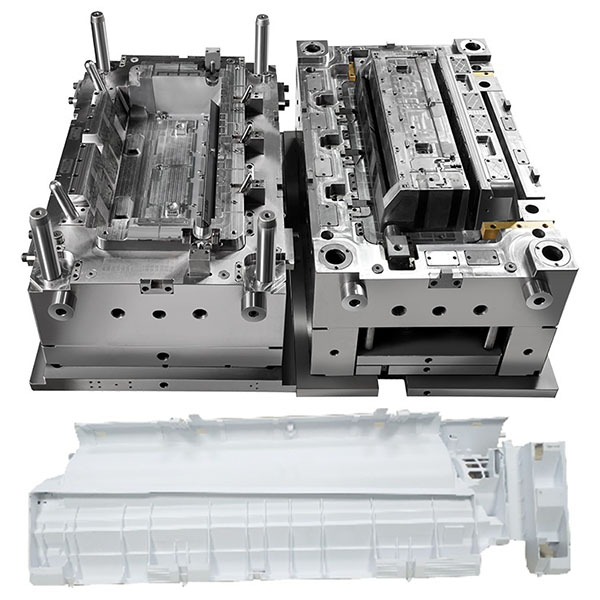
air conditioner mid-frame injection mould durable design
air conditioner mid-frame injection molds are used for mass manufacturing of mid-frame parts for air conditioner housings, primarily providing structural functions such as front and rear cover connection, panel locating, fan and duct positioning, electronic component support, and accessory installation.
Description
air conditioner mid-frame injection molds emphasize dimensional accuracy, assembly fit, structural rigidity, and surface quality, accommodate various engineering plastics and surface texture requirements, and are widely used in the production of residential and commercial air conditioner units and components.
typical applications:
- mid-frames, support frames, and intermediate partitions for indoor or outdoor units.
- mounting bases and locating structures for circuit boards and control assemblies.
- locating and guiding structures for fans, air ducts, filters, and outlet components.
- combined functional parts integrating snaps, stud positions, and insert locations to reduce secondary assembly.
mold structure and design considerations:
- cavity configuration and layout: choose single-cavity or multi-cavity designs based on part size and target production volume; for left-right symmetric or multiple-version parts, consider matched molds or interchangeable cores.
- gating system: prioritize hot-runner or cold-runner selection according to material and appearance requirements; use micro gates or valve-pin gates in thin-wall or appearance-critical areas to minimize gate marks.
- cooling circuits and temperature control: equivalent cooling circuits and localized heating/temperature-control designs can significantly reduce warpage and dimensional drift and shorten cycle time.
- cavity and datum machining: require fine machining and stable reference positioning for assembly datum surfaces and locating holes; apply hard chrome plating or mirror finishing where necessary to improve wear resistance and surface quality.
- ejection and lateral mechanisms: design side-pulls, sliders, or compound ejection mechanisms for snaps, internal bosses, or post-insert locations to protect thin ribs and small features from damage or deformation.
- stress control and flow balance: reduce flow-induced stress concentrations and uneven shrinkage through proper rib layout, wall-thickness transitions, chamfers, and trimming-position arrangements.
common materials and material selection recommendations:
- common engineering plastics: ABS, PC, ABS, PC, PPE, PA (with glass-fiber reinforcement), and TPE (for elastic contacts or seals).
- functional requirements: for parts near electrical components or requiring flame retardancy, prioritize materials that meet UL94 or relevant flame-retardant ratings; for long-term exposure or high-temperature environments, consider heat-resistant and anti-yellowing formulations.
- material selection considerations: mechanical strength, fatigue resistance, dimensional stability, heat and weather resistance, surface machinability, and cost.
injection molding process and production flow:
- trial molding and parameter verification: initial trial molding should verify fill patterns, holding-pressure profiles, cooling effectiveness, and warpage behavior; optimize design using moldflow analysis (Moldflow) when necessary.
- process locking: confirm injection speed, holding time/pressure, mold temperature, and cooling time, and create process specifications (SOPs) and control charts.
- mass production and online control: use SPC, online appearance inspection, and sampling of key dimensions to ensure stability, and establish alarm and line-stop handling procedures for abnormalities.
- post-processing and assembly preparation: perform deburring, insert assembly, stud insertion or heat staking, and complete functional and fit inspections prior to assembly.